





Wear OS 7 was announced on May 19, 2026, during Google I/O, with 10% more battery life and the arrival of Gemini Intelligence on certain watches by the end of the year.
The platform is getting a makeover on three fronts simultaneously: interface, energy performance, and artificial intelligence. Google presents this update as one of the most significant in Wear OS history, and the first technical specifications confirm a real ambition, even if several flagship features remain reserved for hardware that has not yet been announced.
A redesigned interface: widgets replace Tiles
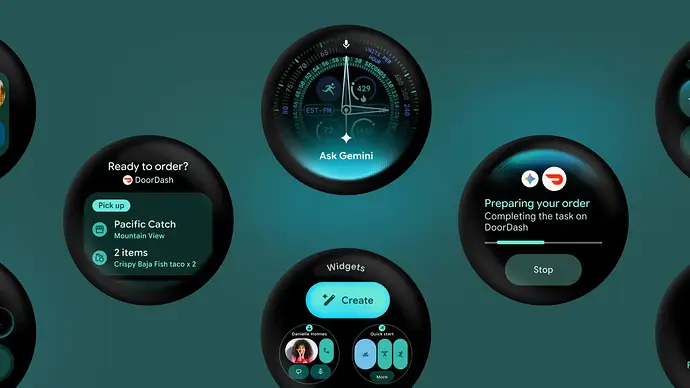
The most visible change for the user concerns the abandonment of Tiles, these full-screen displays that we scroll through horizontally for several generations. Google is replacing them with a widget system available in two distinct formats, 2x1 and 2x2. The goal is to align the watch's visual experience with that of smartphones and tablets running Android 16, by offering more flexible and interactive information blocks.
These widgets don't just display data: they are interactive, allowing, for example, to initiate a call to a saved contact or control music playback directly from the watch face. For developers, Google indicates that the transition from the old Tile system to the new widgets has been designed to be simple. However, unlike Samsung's implementation on Galaxy Watches, it will not be possible to stack multiple widgets on the same screen in Wear OS 7.
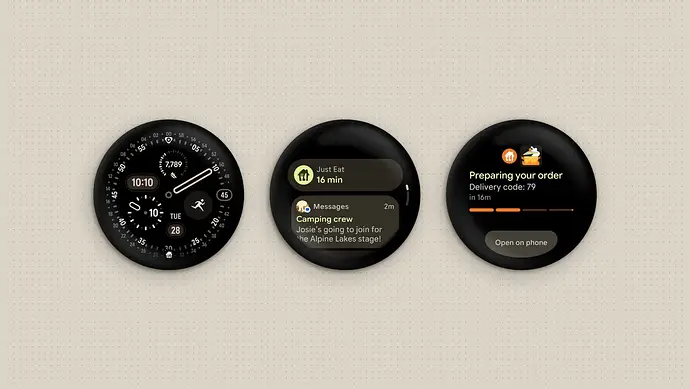
Live Updates complement this interface overhaul. These dynamic notifications appear directly on the main watch face as a compact icon, then expand to display real-time information depending on the application concerned, such as a delivery timer for an ongoing order. Google specifies that for compatible partner manufacturers, Live Updates published by a phone app will be automatically relayed to the user's watch.
Battery life: 10% gain, solely through software
Google confirms that watches upgrading from Wear OS 6 to Wear OS 7 can expect up to 10% improvement in average battery life, achieved through software optimization alone. This figure is presented as an average, and its concrete impact will depend on the watch model and usage habits.
A Wear OS engineer stated to The Verge at the announcement of Wear OS 6 that battery progress was "a few centimeters ahead" and that gains were not uniform across devices or usage modes. Wear OS 7 is no exception, and no independent benchmark data accompanies today's announcement. It is therefore a commitment to be taken with caution, even if the progress remains appreciable on devices where every hour of battery life counts.
Gemini Intelligence: the big promise, with its conditions
Google confirms the arrival of Gemini Intelligence on certain watches launching later in 2026. In other words, no existing model will benefit from this advanced intelligence layer, and not all future new watches will be affected either.
According to information published by Stuff, Gemini Intelligence requires a powerful chipset compatible with Google Nano v3, which suggests that only models equipped with the Snapdragon Wear Elite processor, designed for embedded AI, could fall into this category. Google has not yet released an official list of eligible devices. It should also be recalled that Gemini was already available on Wear OS 4 and later versions since July 2025, on Pixel, Samsung, OPPO, OnePlus, and Xiaomi devices, according to Google's official blog. What Wear OS 7 brings is a deeper integration layer, not the assistant itself.
AppFunctions API: when the watch goes beyond simple notifications
The real paradigm shift in this version lies in theAppFunctions API. This programming interface allows third-party developers to connect their applications to Gemini, so that users can perform tasks by voice command or natural language instruction, outside of Google applications. The use case highlighted by Google is explicit: saying "start tracking my run" directly triggers the Samsung Health application, without any screen being manually opened.
Google also offers a task automation system that requires no additional development from app publishers, allowing, for example, to place an order via DoorDash from the wrist. An early access program is open today for developers wishing to integrate their applications into this infrastructure. One limitation remains unchanged: Gemini requires an active internet connection. The Wear OS team had mentioned exploring an offline functionality last year, without a precise timeline. This announcement does not change that status quo.
Fitness and media: everyday novelties
Google introduces a Wear Workout Tracker standardized system, allowing third-party sports apps to use the interface and technology of Google's system apps rather than recreating their own experiences. ASICS Runkeeper is the first major partner to adopt this system, which integrates heart rate tracking, media controls, and other essential sports functions. Google's goal is to unify the fitness experience across the entire Pixel Watch ecosystem, reducing fragmentation between different apps.
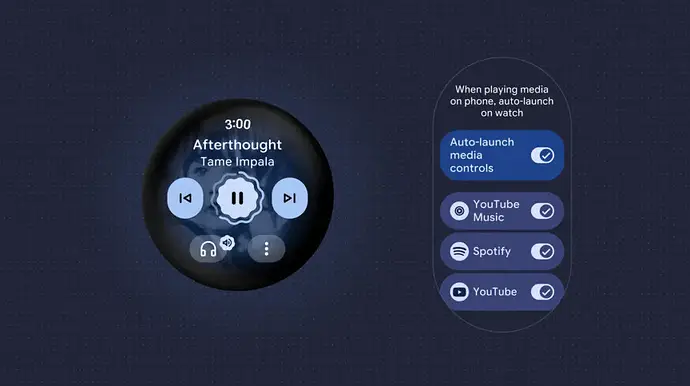
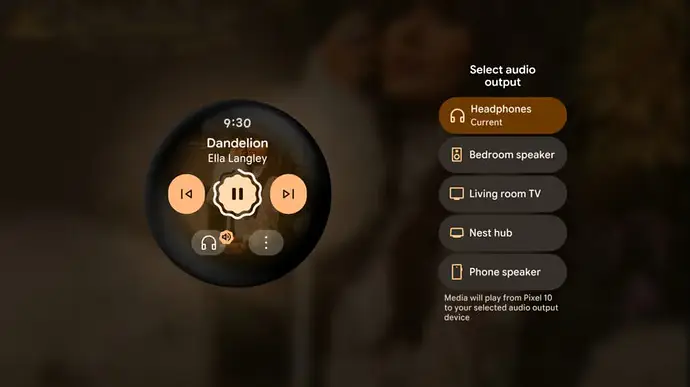
The media player also benefits from concrete improvements: a new audio output switch allows users to choose the sound destination directly from the watch, whether via Bluetooth or Google Cast, without touching their phone. Automatic launch controls per app also allow the user to decide, on an app-by-app basis, whether the player interface automatically appears as soon as playback starts.
Availability: first for developers
Wear OS 7 Canary is available starting today for developers via an emulator, to allow app testing. The public rollout on compatible watches is planned for later in 2026. Google has not communicated a precise date or a definitive list of models that will receive the update, whether for basic functions or for the Gemini Intelligence layer.
Wear OS 7 represents a substantial update that repositions Android on the wrist as a coherent and more ambitious ecosystem. The interface redesign with widgets, the gain in battery life through software optimization, and the opening of Gemini to third-party apps outline a platform that ceases to be a mirror of the smartphone to become a full-fledged assistant. The question of Gemini Intelligence availability, still unclear for existing models, will be the real test of Google's promise in the coming months. Announcements of new Pixel Watch models are to be closely watched.

No Comment! Be the first one.