





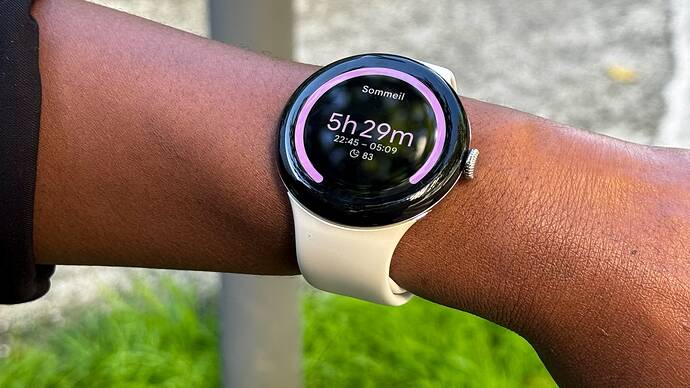
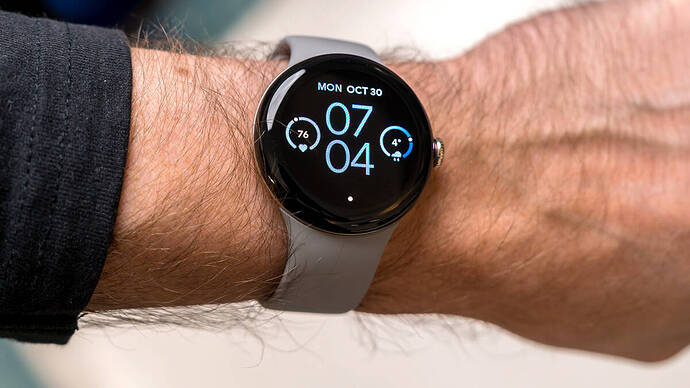
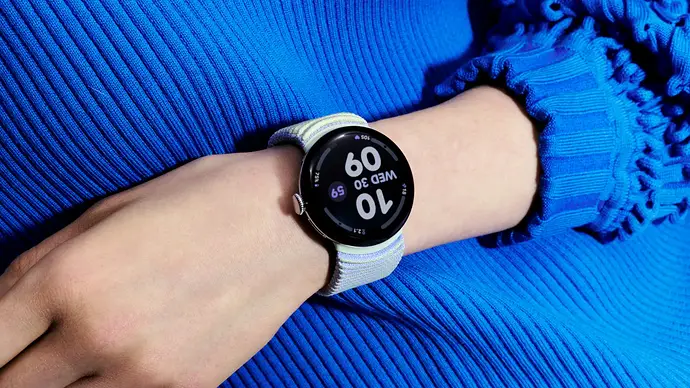
The Pixel Watch is affected by a new bug that prevents sleep data from being displayed directly on the watch, just days before the launch of Google Health.
"No recent data": when the watch lies to its user
Pixel Watch owners have been reporting a persistent anomaly upon waking for several days. The watch displays the message "No recent data. Wear your watch to sleep.", even though the user slept with the band on their wrist. The phenomenon is all the more confusing because sleep tracking actually works: the data remains accessible in the Fitbit app on the smartphone, but it no longer appears on the watch face itself.
This discrepancy between what the watch displays and what the app records makes the problem difficult to diagnose at first glance. For many users, checking their stats directly on their wrist upon waking is one of the main attractions of this type of connected bracelet. Having to pull out their phone to find this information goes against the fundamental promise of a smartwatch.
The Pixel Watch 2 in the spotlight
The problem mainly affects owners of Pixel Watch 2, although other generations have also been mentioned by users on community forums. Several people have confirmed encountering the same bug on Reddit, where the original discussion thread quickly gathered numerous replies from owners in the same situation. As of the publication date of this article, Google has not yet provided an official explanation for the cause of the malfunction, nor has it communicated a timeline for a fix.
This situation occurs during a particularly turbulent period for Google's health ecosystem. In March 2026, a Fitbit firmware update (version 3.57.1.2.910093395.release) had already caused the blood oxygen saturation (SpO2) and skin temperature measurements to stop working on several generations of Pixel Watch. Complaints quickly flooded Reddit, then the Fitbit Community forum and the official Pixel Watch support forum, concerning the Pixel Watch 2, 3, and 4 models, with data missing in the app despite being worn overnight.
A series of bugs that undermine user trust
The March 2026 bug had an identified technical cause: the update silently removed sensor access permissions. When users tried to restore these permissions in the settings, a message indicated that no application was requesting access, leaving them in a deadlock.
The official PixelCommunity account acknowledged the problem on Reddit, stating: "We regret the disruption to your health tracking experience caused by these permission resets." (We regret the disruption to your health tracking experience caused by these permission resets.) A Fitbit representative also confirmed that work was underway to restore sensor access.
These repeated bugs are beginning to seriously erode the trust of some users. According to Gadgets & Wearables, some have reported similar problems repeatedly over a period of one year, affecting sleep tracking, step counting, SpO2 measurements, and synchronization in turn. One user even indicated that they had disabled automatic updates to avoid further interruptions, and another admitted to only discovering the cessation of their oxygen saturation tracking by checking the app several days after the fact. This is precisely where the structural problem of passive health functions lies: designed to work in the background without intervention, they can fail silently for several nights before a user notices.
The migration to Google Health, a complex backdrop
These bugs occur at a particularly sensitive time for the entire ecosystem. According to Google's official help, the Fitbit app will be replaced by Google Health starting May 19, 2026. This migration is accompanied by a complete overhaul of the interface, with four main tabs (Today, Fitness, Sleep, and Health), as well as the integration of a Gemini-powered coach for premium subscribers.
As part of this transition, the social features of the app were suspended starting May 12, 2026, a pause that Google presents as necessary to prepare for the new experience. It would be premature to establish a direct causal link between these behind-the-scenes changes and the sleep data display bug that appeared this week on some watches. But the temporal coincidence is worth noting, and Google has so far provided no explanation.
Sleep data: what to do while waiting for a fix?
In the absence of an official fix, several workarounds can mitigate the problem. A product expert on the official Pixel Watch support forum recommends clearing the cache of the Fitbit app on both the phone and the watch, then restarting both devices. A manual sync (by pulling down from the main screen of the Fitbit app) can sometimes force an update of the displayed data. In the most persistent cases, a complete reset of the watch has proven effective for a number of users, although it involves reconfiguring the device from scratch.
It is also advisable to regularly check the health dashboard in the Fitbit app, particularly the sections dedicated to SpO2 and skin temperature, in order to quickly detect any interruption in tracking without waiting to see its effects on the wrist.
The sleep tracking is one of the most valued features of the Pixel Watch line. Seeing this promise weakened by repeated software bugs, precisely at a time when Google is seeking to strengthen the credibility of its health ecosystem through the launch of Google Health, represents a worrying signal. Affected users are encouraged to report the problem via the official Pixel Watch support forum to expedite support from Google teams.

No comments! Be the first one.