





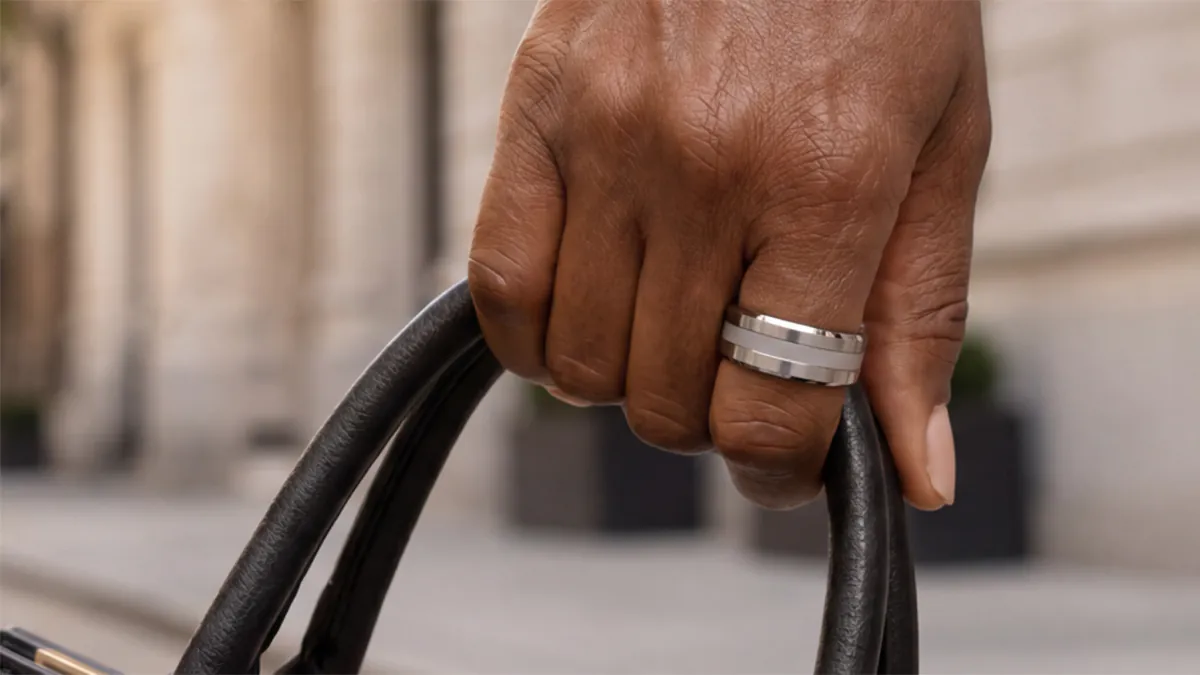
Signal Ring promises to measure blood pressure on the finger, without a cuff or calibration. Sold for $399, this ring remains, however, a wellness product not approved by the FDA.
Presented on July 16, 2026, by the American startup Vital Signals, Signal Ring does not seek to become another generalist tracker. Its objective is more precise and significantly more ambitious: to provide systolic and diastolic values, track their variations throughout the day, and build a cardiovascular history without requiring a cuff-based blood pressure monitor.
Signal Ring wants to transform blood pressure measurement
Most smart rings monitor sleep, heart rate, heart rate variability, or skin temperature. Signal Ring focuses almost entirely on blood pressure, with on-demand readings and automatic background monitoring.
This difference is important. Devices like the Oura Ring already analyze cardiovascular signals to identify trends, but they are not designed to replace a blood pressure monitor. As we explained during the launch of the Oura Ring 5 and its Health Radar, Oura presents its blood pressure information as a preventive tracking tool, complementary to measurements taken with a cuff.
Vital Signals claims to go further. The ring is intended to display understandable systolic and diastolic values, as well as represent the evolution of average blood pressure throughout the day. The user could thus observe the effects of sleep, physical activity, coffee, stress, or other events on their data.
How this connected ring measures blood pressure
Signal Ring uses a high-speed optical sensor placed against the finger. This observes the shape and timing of the pulse wave produced with each heartbeat. A physiological model then translates these optical variations into an estimation of blood pressure.
According to Vital Signals, the sensor would record changes in blood flow four to five times faster than other blood pressure trackers. The company maintains that this resolution allows its algorithms to distinguish a real pressure change from a change in arterial tone or geometry.
Vital Signals
The American Heart Association reminds us that the quality of a PPG signal can be affected by movement, sensor position, pressure against the skin, temperature, vessel stiffness, and certain physiological characteristics. The finger is nevertheless an interesting location, as digital arteries can provide a more usable signal than the back of the wrist.
Three modes to understand daily variations
Signal Ring offers a real-time reading mode that updates information every ten seconds. A guided mode, called Zen Mode, asks the user to adopt a stable posture, slow their breathing, and remain calm during the measurement.
This procedure is not just for comfort. Talking, moving, crossing your legs, drinking coffee, or measuring your blood pressure immediately after exertion can alter the result. The posture and breathing instructions therefore aim to reduce variations related to measurement conditions.
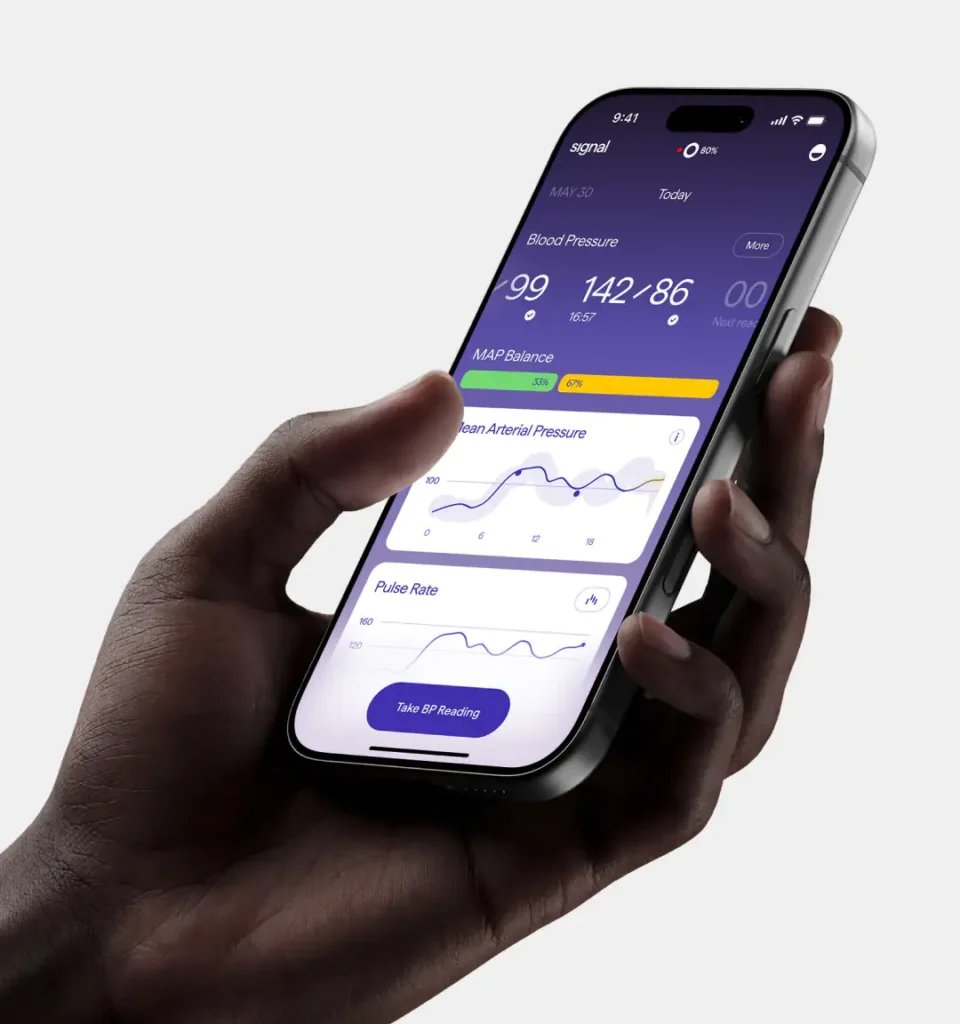
In parallel, the ring takes automatic readings. These feed into a graph of mean arterial pressure, or MAP, intended to represent fluctuations throughout the day. This approach could provide context that a single cuff measurement does not show, particularly during sleep or daily activities.
However, the quantity of data must be distinguished from its clinical quality. Hundreds of readings only become useful if the device maintains sufficient accuracy in real-world situations, including when the user is walking, sleeping, changing posture, or taking medication that affects blood pressure.
Measurement without a cuff and without calibration
Signal Ring's main promise lies in the complete absence of calibration. Several wearables capable of estimating blood pressure must first be compared to a traditional blood pressure monitor and then recalibrated periodically. Their algorithm uses this initial value as a reference.
Vital Signals claims that its ring reconstructs each reading from the user's physiology. Therefore, there would be no starting value to record and no regular calibration to perform.
This claim is technologically appealing, but it is still a manufacturer's promise. The public pages consulted do not provide a complete clinical protocol, detailed numerical results, population-based analysis, or peer-reviewed scientific publication that would allow independent verification of the announced accuracy.
What is confirmed about Signal Ring
The commercial and hardware features are now official. Signal Ring costs $399 and does not require a subscription. Pre-orders are open in the United States, with shipments expected to begin in October 2026.
The ring will be available in US sizes 5 to 13. It combines an outer titanium surface with a resin interior and features IP68 water resistance announced up to 3 meters for 30 minutes. It communicates with Android smartphones and iPhones using Bluetooth Low Energy.
A connection to a nearby phone is necessary to sync measurements with the app. This app gathers readings, their context, and the average blood pressure graph.
Vital Signals announces a three-day battery life. The provided case could perform four additional recharges. This endurance is lower than that of several smart rings dedicated to sleep or activity, but the more intensive operation of the optical sensor may explain higher consumption.
What remains to be demonstrated before launch
Signal Ring has not received FDA market authorization to measure blood pressure. The Official Product FAQ describes itself as a wellness device intended to encourage a healthy lifestyle, not as a medical or diagnostic device.
This distinction is essential. In September 2025, the FDA advised against the use of unauthorized wearables, including watches and rings, when they claim to measure or estimate blood pressure. An incorrect value can delay a consultation, cause undue worry, or lead to inappropriate changes in treatment.
In January 2026, the US agency also published draft recommendations for clinical trials of non-invasive, cuffless blood pressure monitors. This document, still provisional and non-binding, emphasizes the importance of testing devices in multiple positions, physiological situations, and populations, rather than in a single controlled environment.
The American Heart Association adopts a similar stance. In a scientific statement published in December 2025, the organization believes that cuffless technologies are promising but not yet sufficiently validated to diagnose hypertension or guide treatment. It recommends continuing to use a validated device when medical decisions depend on the result.
Why this technology remains highly anticipated
The potential medical interest far exceeds the gadget market. According to the World Health Organization, approximately 1.4 billion adults aged 30 to 79 were living with hypertension in 2024. Nearly 600 million of them were unaware of their condition.
A discreet ring capable of monitoring blood pressure over several days could help detect variations that are difficult to observe during a consultation. It could notably reveal nocturnal trends, reactions to certain activities, or episodes that escape occasional measurements.
Signal Ring will, however, have to prove that its algorithm works on users of different ages, skin tones, and cardiovascular profiles. It will also be necessary to verify its resistance to movement, temperature changes, and position variations. The comparison with reference devices must cover real-world conditions, not just measurements taken at rest.
Signal Ring therefore offers one of the most interesting ideas on the current wearables market: replacing the constraint of a cuff with silent, contextualized monitoring. But until the publication of independent validation and eventual regulatory approval, its values should remain wellness information. People monitoring hypertension or adjusting treatment should continue to use a validated blood pressure monitor and interpret their results with a healthcare professional.




No comments! Be the first one.