





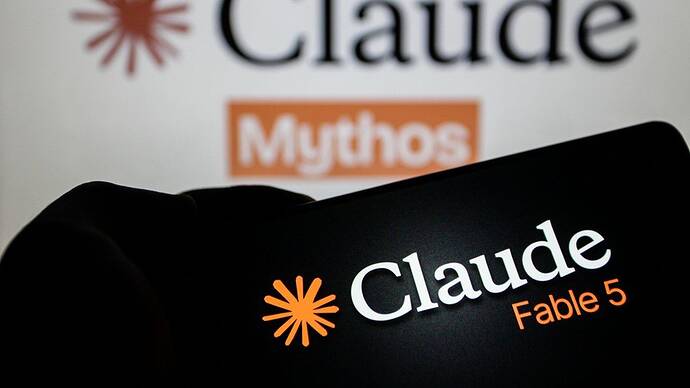
Fable 5 and Mythos 5 Anthropic's Fable 5 and Mythos 5 were abruptly deactivated on June 12, 2026, by order of the US government. A first in the history of the artificial intelligence industry.
Just three days after their public launch, Anthropic's two most powerful models disappeared from servers. The pretext: a potential jailbreak deemed a threat to national security. The reality, according to Anthropic itself, is much more nuanced.
A Record Launch, A Brutal Shutdown
On June 9, 2026, Anthropic released Claude Fable 5, the first Mythos-class model accessible to the general public, along with Claude Mythos 5, its version with partially lifted safeguards, reserved for a select group of cybersecurity specialists. According to Anthropic's official press release dated June 9, 2026, Fable 5 represented "the state of the art on almost all tested benchmarks," with exceptional performance in software engineering, scientific research, and long-context tasks.
The distinction between the two models lay solely in their safeguards. Fable 5 integrated security classifiers that automatically redirected to Claude Opus 4.8 for any sensitive query related to cybersecurity, biology, or chemistry. This mechanism was activated in less than 5% of sessions on average. Mythos 5, on the other hand, shared the same underlying model but with these restrictions lifted in certain areas, deployed as part of the Glasswing Program in collaboration with the US government.
The announced price: $10 per million input tokens and $50 per million output tokens, less than half the price of the previous Mythos Preview model.
The Department of Commerce Directive: An Expedient Decision
On June 12, 2026, at 5:21 PM (Eastern Coast time), Anthropic received an export control directive. The injunction was clear: immediately suspend all access to Fable 5 and Mythos 5 for any foreign national, whether on US territory or not, including Anthropic's own foreign employees.
In its official press release published on June 12, Anthropic specified that "the letter did not provide specific details of its national security concern." The government had nevertheless verbally informed the company of the existence of a method to bypass the model's safeguards.
The direct consequence of this order creates a technical paradox: to ensure full compliance with the restriction targeting foreign nationals, Anthropic had no choice but to disable both models for all its clients, including US citizens. In the same official statement, the company specified that "access to all other Anthropic models will not be affected."
A Minor Jailbreak Elevated to a National Threat
At the heart of this decision lies a so-called "non-universal" jailbreak, a technique that allows for partial bypassing of a model's safeguards under very specific conditions. According to Anthropic's official press release of June 12, the method essentially consists of "asking the model to read a specific codebase and correct its software flaws."
Anthropic reviewed the report it believes to be the origin of the directive and vigorously contested its concerning nature. The company stated in the same press release that "the level of capability described is widely available on other models, including OpenAI's GPT-5.5," and that this technique is "used every day by defenders responsible for system security."
Anthropic's defense relies on a solid track record. Before its launch, the company collaborated with the U.S. government, the UK's AI Safety Institute (AISI), and several private third-party organizations to test Fable's safeguards over thousands of hours of red-teaming. No tester managed to find a universal jailbreak, meaning a method capable of bypassing the model's protections for a wide spectrum of cybersecurity capabilities. This outcome was anticipated by Anthropic itself in its official launch post: the company explicitly stated that perfect resistance to jailbreaks was "not currently possible for any model provider."
The "Defense in Depth" Strategy Put to the Test
Faced with this technical reality, Anthropic adopted a documented defense-in-depth approach for Fable 5. The goal was to make jailbreaks either very narrow in scope for non-universal ones or very costly to produce for universal ones, combined with enhanced monitoring. This is also why Anthropic imposed a 30-day data retention policy for its Mythos-class models, a policy acknowledged in the official press release as having "a real cost for customers" but necessary to "research and mitigate jailbreaks."
In its June 12th press release, Anthropic maintained its unambiguous position: "We are complying with the government’s legal directive and are removing access to Fable 5 and Mythos 5 for all users. However, we disagree that the finding of a narrow potential jailbreak should be cause for recalling a commercial model deployed to hundreds of millions of people." (We are complying with the government’s legal directive and are removing access to Fable 5 and Mythos 5 for all users. However, we disagree that the finding of a narrow potential jailbreak should be cause for recalling a commercial model deployed to hundreds of millions of people.)
A Precedent with Potentially Crippling Consequences for the Industry
The scope of this decision extends beyond Anthropic alone. In its official statement, the company articulated this explicitly: "If this standard was applied across the industry, we believe it would essentially halt all new model deployments for all frontier model providers." (If this standard was applied across the industry, we believe it would essentially halt all new model deployments for all frontier model providers.)
The situation draws a parallel with Huawei's blacklisting by the U.S. Department of Commerce in 2019. That decision cut off the Chinese giant from American chips and software in the name of national security. However, the Anthropic case reverses the logic: for the first time, the U.S. government is recalling its own domestic software assets for geopolitical reasons, affecting its own citizens in the process.
If this type of intervention becomes systematic, any vulnerability discovered in a U.S. AI model could trigger an immediate commercial shutdown. This represents a commercial and reputational risk that is difficult for companies that have invested billions of dollars in research and development to absorb.
Anthropic indicated in its press release that it had been publicly discussing its AI policy for several weeks, advocating for "the government to have the ability to block unsafe deployments, as part of a transparent, fair, clear, and technically grounded legal process." The company believes that the June 12, 2026 directive "does not meet these principles" and is continuing its discussions with authorities to secure a prompt restoration of access.
This standoff between the world's leading AI startup by valuation and its own government raises a question that the entire industry will have to resolve: to what extent is the United States prepared to hinder its own technological champions in the name of national security, and what transparent regulatory doctrine can prevent arbitrary decisions? The answer given in the coming days will determine both the fate of Fable 5 and the rules of the game for the entire next generation of AI models.



No comments! Be the first one.