






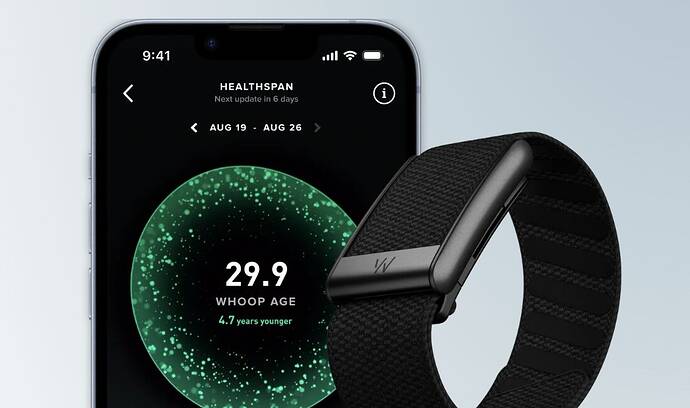
Whoop filed a 111-page complaint against Bevel, the application that allows Apple Watch and Garmin watch users to access health metrics similar to those of the Whoop bracelet. Filed on March 17, 2026, in the Delaware District Court, this lawsuit could redefine the boundaries of intellectual property in the connected health application sector.
An accumulation of legal grievances
Whoop, valued at $10 billion, accuses Bevel of violating its trade dress, its copyrights, and four of its patents. Trade dress here refers to the visual appearance and user experience of an application: Whoop claims that Bevel's interface resembles its own enough that a consumer could confuse the two products. The complaint cites specific elements, such as the use of colored circular rings to display effort and recovery scores at the top of the main screen, and the use of the terms "Strain" and "Recovery" to qualify these metrics.
The patent dimension strengthens the case's scope. Whoop invokes four patents covering the processing of biometric data and the calculation of recovery scores, extending the attack far beyond a simple design dispute. For Bevel, a startup with 500,000 users, the stakes are existential against an opponent with incomparable resources.
A history of negotiations that turns into conflict
The relationship between the two companies did not start in the pre-litigation phase. According to Grey Nguyen, CEO and co-founder of Bevel, Whoop first attempted to establish a collaboration in 2024, before sending a cease and desist letter several months later. Whoop then demanded that Bevel disable its dark mode and abandon the terms "Strain" and "Recovery" in its interface.
Bevel refused these requests and mandated its lawyers to respond. Legal exchanges then continued for several months, until May 2025, when Whoop ceased all communication. Then, without notice, the formal complaint was filed in March 2026, as explained by Grey Nguyen in a response video published on YouTube and X.
Bevel's defense: prior designs and a refusal to yield
Grey Nguyen strongly disputes the accusations. "Instead of prioritizing product development and innovation, Whoop has chosen to allocate its newly raised funds to legal battles," said Grey Nguyen, CEO of Bevel, in a response video published on X. ("Instead of prioritizing product development and innovation, Whoop has opted to allocate its newly acquired funds towards legal battles.")
Bevel's central argument relies on chronology. The company claims to have dated screenshots from December 2023 showing that its designs existed before the elements for which Whoop claims paternity, which would directly weaken the plagiarism claim. This point of chronology is central: if Bevel manages to establish that its design choices predate or are independent of Whoop's, the trade dress argument loses much of its solidity.
A legal strategy that goes beyond the Bevel case alone
This lawsuit is not happening in a vacuum. In 2025, Whoop had already sued the Chinese manufacturer Lexqi for physical product infringement and obtained a preliminary injunction blocking its sales. The Bevel case marks a notable evolution: Whoop is now extending its claims to the software domain, where trade dress protections are legally less established than for hardware.
Several observers also point to the timing of the lawsuit. Whoop had just raised $500 million in a recent funding round, and some analysts believe that consolidating its intellectual property could pave the way for an IPOProtecting brand image and the perceived uniqueness of its interface before such an operation is a coherent strategic motive.
What Bevel offers and why it's causing problems
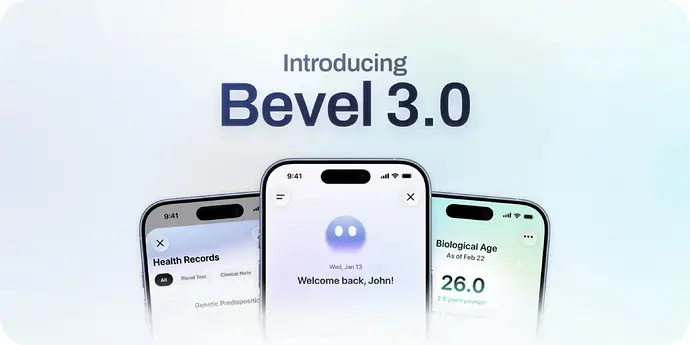
Bevel occupies a niche that Whoop does not directly cover: the application works without proprietary hardware, relying on data collected by an Apple Watch, a Garmin watch, or an Oura ring. It offers free tracking based on effort, recovery, and sleep scores, as well as a paid subscription cheaper than Whoop to access analysis by generative artificial intelligence.
It is precisely this value proposition that is causing problems. Bevel offers an experience close to Whoop to millions of people who already own an Apple Watch or a Garmin watch, without purchasing additional hardware. Whether Whoop calls this plagiarism or a strategy to capture its own clientele, the line between legal inspiration and illicit copying will be drawn by the Delaware judges.
The outcome of this case will go beyond the parties involved. If the courts grant Whoop protection for its software interface, it will set a precedent that could force many health applications to redesign their interfaces. In the meantime, Bevel announces a major update to its application, signaling its intention to continue to exist despite legal pressure.


No comments yet — start the discussion!