






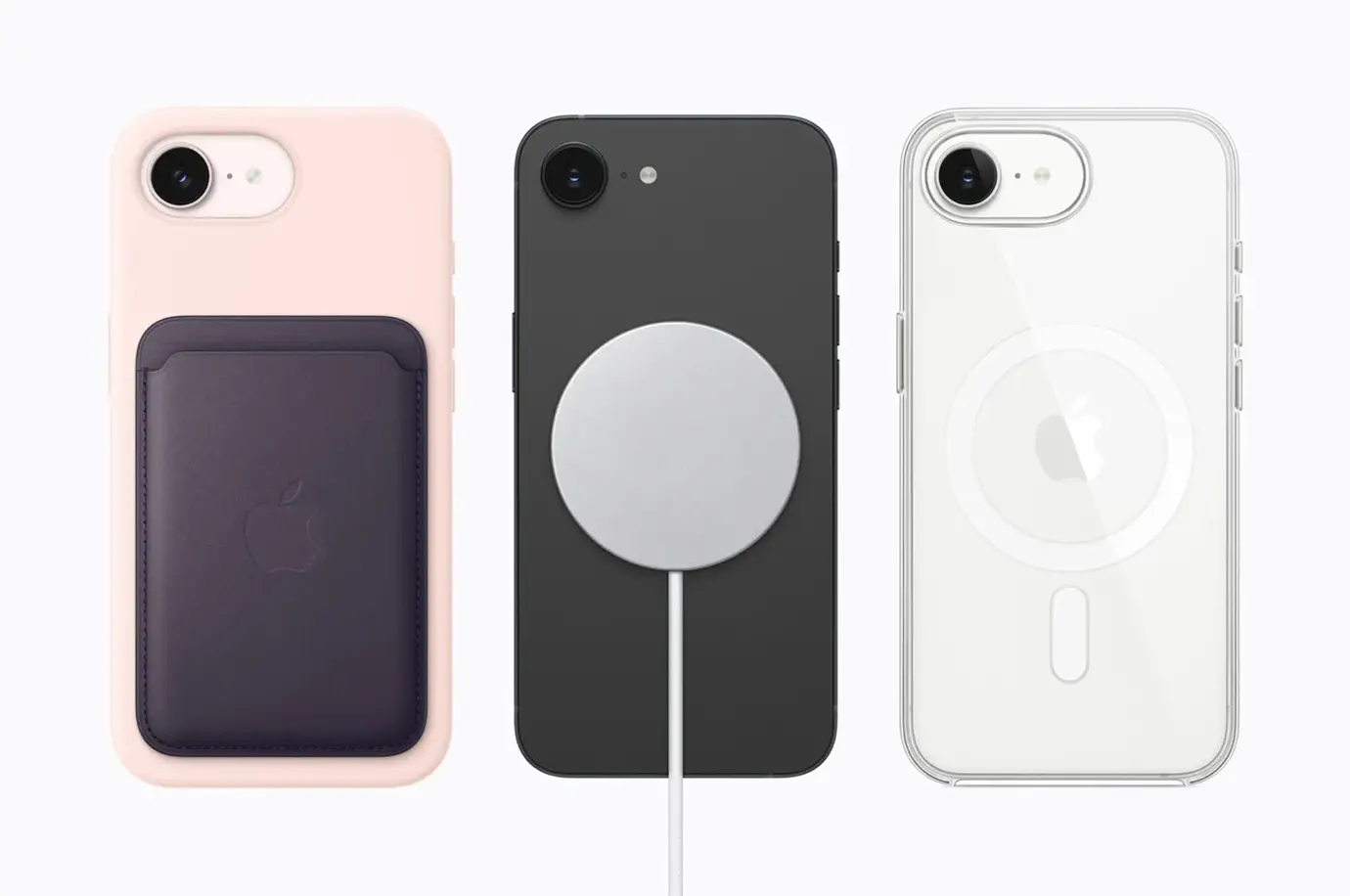
The iPhone 17e is official since March 2, 2026: A19 chip, MagSafe, and doubled storage, all at the same price as last year. Apple is boosting its most accessible model without raising its price, a rare decision in the brand's pricing strategy.
The A19 Chip: The Central Argument
If there were only one reason to justify this move to the 17e, it would be the chip. The iPhone 17e features the A19 etched in 3 nanometers, the same silicon that powers the standard iPhone 17, minus one GPU core. Its CPU has 6 cores, its GPU has 4 cores (compared to 5 on the standard iPhone 17), and its 16-core Neural Engine handles local artificial intelligence task processing.
Apple announces performance up to twice as high as the iPhone 11, according to the official press release. For a model priced under 750 euros, accessing the same level of power as the previous year's flagship is significant. This is a change in philosophy compared to the SE years, where hardware compromises were much more visible.
The 16-core Neural Engine is also the gateway to Apple Intelligence, Apple's generative AI system integrated into iOS 26. Notification summaries, image generation, text rephrasing: all these functions now run locally on the 17e, without a mandatory cloud connection.
A New Modem and Stabilized Battery Life
Under the hood, the other major innovation is the C1X modem, from the iPhone Air, which succeeds the C1 introduced on the iPhone 16e. This component designed in-house by Apple offers cellular connectivity up to twice as fast as its predecessor, according to data provided by Apple.
Battery life remains within a reasonable range for this form factor. Apple announces up to 26 hours of video playback, a figure that places the iPhone 17e in the upper average of its category. The 4,005 mAh battery powers a 6.1-inch Super Retina XDR OLED display with a resolution of 1170 x 2532 pixels, a density of 457 ppi, and a maximum HDR brightness of 1,200 nits.
MagSafe, Ceramic Shield 2: What's New on the Front
The iPhone 16e was criticized for two notable omissions: MagSafe and an updated screen protection. Apple corrects both. MagSafe compatibility is now integrated, which opens access to the brand's entire ecosystem of magnetic accessories, from cases to chargers.
The front adopts the Ceramic Shield 2, reinforced protection already present on the iPhone 17 Pro models. The chassis remains aluminum with a glass back. Water and dust resistance certification is maintained.
iPhone 17e Technical Specifications
| Feature | iPhone 17th (2026) | iPhone 16e (2025) |
|---|---|---|
| Chip | A19 (3 nm) | A18 |
| GPU Cores | 4 | 5 |
| Modem | C1X | C1 |
| RAM | 8GB LPDDR5X | 8GB |
| Base Storage | 256GB | 128GB |
| Display | 6.1-inch OLED, 1200 nits | 6.1-inch OLED |
| Camera | 48 MP, 4K | 48 MP |
| MagSafe | Yes | No |
| Front | Ceramic Shield 2 | Ceramic Shield |
| Video playback | 26 h | Not disclosed |
| Launch price | 719 euros (256 GB) | 719 euros (128 GB) |
Camera and Gaming
The48-megapixel main camera allows 4K video capture. The 16-core Neural Engine accelerates computational photography processing, from Portrait Mode to Smart HDR, with a fluidity that the older A15 or A16 chips in the SE models could not achieve.
The A19's 4-core GPU integrates support for hardware ray tracing, a technology that improves lighting rendering in AAA games available on the App Store. On an accessible smartphone, this is a capability that was only recently found reserved for iPhone Pro models.
719 Euros for More Storage
The launch price remains at 719 euros, identical to that of the iPhone 16e upon its release in 2025, but the base configuration increases from 128 GB to 256 GB. For equivalent storage, the iPhone 17e is therefore practically cheaper than its predecessor. Apple also offers a 512 GB version for 969 euros. The smartphone is available in three colors: pastel pink, white, and black, with pre-orders open since March 4, 2026, and in-store availability starting March 11.
In a market where the Google Pixel 10a and the Samsung Galaxy A56 5G play in the same price range with strong arguments, Apple is betting on the coherence of its ecosystem, the power of the A19, and the integration of Apple Intelligence to defend the positioning of the 17e. For users coming from an iPhone SE third generation or a model older than the iPhone 14, the qualitative leap is significant enough to justify the upgrade. The real question is whether Apple confirms, with this 17e, its intention to annualize the releases of its most affordable iPhone, a strategy that would ultimately benefit the greatest number.


No comments! Be the first one.