





The Xiaomi Smart Band 10 Pro is official as of May 22, 2026. Thinner, better equipped, it promises 98.2% heart rate accuracy for under 60 euros.
Unveiled during Xiaomi's ecosystem event in China on May 22, 2026, the Smart Band 10 Pro was revealed alongside the Xiaomi 17 Max, confirming the manufacturer's intention to refresh its entire connected range in one major event. The band directly succeeds the Smart Band 9 Pro released in 2024 and builds on the same successful formula: a refined design, ambitious sensors, and a hard-to-beat price.
A more compact case, a much brighter screen
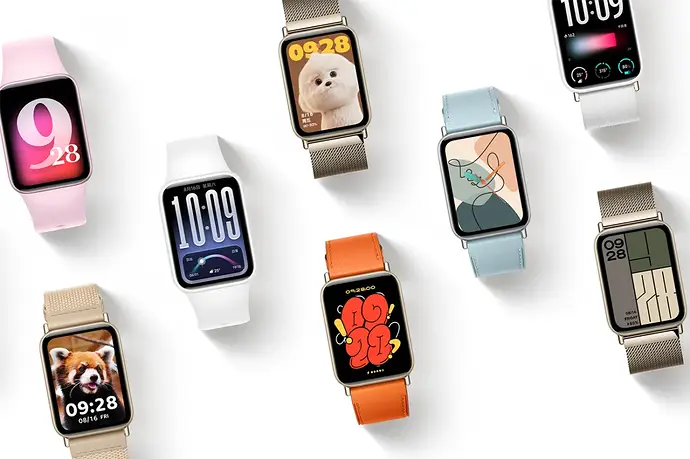
The Smart Band 10 Pro retains the 1.74-inch AMOLED display from its predecessor, with a slightly curved 2.5D glass that enhances its smartwatch look rather than just being a simple tracker. However, Xiaomi has significantly increased the brightness. According to Xiaomi's official specifications, the peak brightness now reaches 2,000 nits, up from 1,200 nits on the Band 9 Pro, a 67% increase that should make readability in direct sunlight much more comfortable.
The casing has been slimmed down to 9.7 mm, weighing 21.6 grams without the strap. Despite this more compact profile, the 350 mAh battery allows Xiaomi to claim the same 21-day battery life under standard usage, or about 8 days with the always-on display enabled. The screen refresh rate is set at 60 Hz.
Superior health sensors
It's in the health features that the Smart Band 10 Pro distinguishes itself most clearly from the previous generation. Xiaomi has integrated a new, latest-generation dual-light PPD sensor, capable of achieving 98.2% accuracy for heart ratemeasurements. Blood oxygen saturation (SpO2) measurement is also included.
The other significant innovation is the introduction of heart rate variability (HRV) tracking during sleep. Combined with the Sleep Algorithm 2.0, this tracking allows, according to Xiaomi, to detect sleep phases with 14% increased accuracy and identify sleep and wake times with 11% greater accuracy compared to the Band 9 Pro.
Cycling, gaming, and iPhone compatibility
The fitness tracker offers over 150 sports modes. The new cycling mode is the most concrete addition: it refines bike data tracking and allows real-time monitoring of muscle fatigue during exertion, a feature previously absent in this price range. Water resistance is certified at 5ATM, which fully covers swim tracking.
Xiaomi has also introduced an unprecedented gaming mode. When activated, the band measures the player's heart rate and stress level, displays game progress, triggers vibrations during critical moments like an imminent respawn, and generates a physical performance report at the end of the session. This type of functionality, still rare at this price point, explicitly targets PC and mobile gamers.
On the software side, the Smart Band 10 Pro runs on HyperOS 3. Xiaomi has strengthened compatibility with the Apple ecosystem: synchronization with Apple Health, notifications on two devices simultaneously, and voice shortcuts similar to Siri Shortcuts are available for iPhone users. The band also integrates NFC, usable for offline payments and transport cards.
Price, versions, and uncertainty about an international launch
The Xiaomi Smart Band 10 Pro is marketed in China since May 22, 2026, in two versions. The standard version, with an aluminum alloy case, is offered at 399 yuan, or about 55 euros. The ceramic version, more premium and slightly heavier, is available at 479 yuan, or about 66 euros. Several colors are available, including black, silver, and pink for the aluminum, and an exclusive white for the ceramic.
Xiaomi has made no announcement regarding an international launch. For comparison, the Smart Band 9 Pro never officially arrived in the United States, even though its global version remained accessible through third-party resellers. If the manufacturer replicates this distribution pattern, a worldwide availability of the Band 10 Pro could occur during the year, with no confirmed date at this stage.
The Xiaomi Smart Band 10 Pro stands out as one of the most consistent updates in the series for several generations: measurable gains in sensors, more precise sleep tracking, a slimmer form factor, and pricing that remains among the most competitive in the segment. For users of a Band 8 or older, the leap clearly justifies the investment. For owners of a Band 9 Pro, the decision will primarily depend on the importance given to heart rate accuracy and HRV tracking. A real-world test will verify if the figures claimed by Xiaomi hold true in daily use.

No comments! Be the first one.