





Siri AI in Europe is blocked since June 8, 2026, because of the DMA. Apple presented concrete technical solutions, all rejected by the European Commission.
What European iPhone users won't see this fall
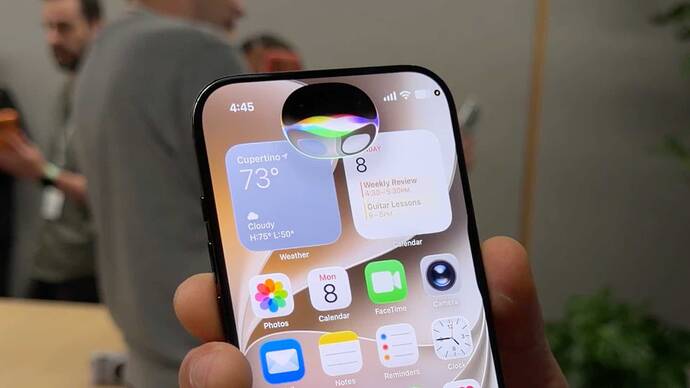
On June 8, 2026, at WWDC26, Apple presented Siri AI, the most profound overhaul of its voice assistant since its launch in 2011. Powered by Apple Intelligence, it no longer responds to isolated commands: it understands the context of a conversation over time, analyzes the content displayed on the screen in real-time, retrieves information from multiple applications simultaneously, and executes complex tasks across the entire operating system. A user can, for example, look at a photo of a place on their screen and directly ask the assistant about it, without formulating an additional text query.
According to Apple's official statement, the approximately 450 million residents of the European Union will not have access, at the launch of iOS 27 and iPadOS 27, to the dedicated application for viewing the exchange history, the extended visual intelligence experience, the integrated writing tools, or the Siri mode in the Camera app. Developers based in the EU will not be able to test or integrate these features into their iOS and iPadOS applications, creating a structural delay for the entire European development ecosystem.
Trusted System Agent: Apple's Technical Proposal
Faced with the requirements of the Digital Markets Act, Apple did not arrive in Brussels without a solution. According to the official statement published by Apple on June 8, 2026, the company designed a specific software architecture called "Trusted System Agent." This is an intermediary that would have allowed third-party virtual assistants to access the same functionalities and capabilities as Siri AI, while maintaining technical protections against documented security risks.
Apple bases its argument on the work of security researchers who have demonstrated that AI systems can be misused to access passwords, copy personal files, or modify account settings without the owner's consent. The Trusted System Agent was designed to frame these accesses, maintaining permanent user control over the data transmitted to third-party assistants. In addition to this technical solution, Apple requested an 18-month phased deployment delay from the Commission to implement this framework while satisfying compliance obligations.
The European Commission rejected both proposals. According to Apple's official statement, none of the solutions submitted by the company were accepted by regulators in the months preceding the announcement.
Siri AI in Europe vs. the DMA: Two Irreconcilable Interpretations
The central disagreement concerns the concrete scope of the interoperability obligation provided for by the DMA. Apple argues that regulators are effectively demanding near-unlimited access to user private data for any competing AI assistant, including the ability to read messages, make purchases, and act within any application without permanent user control. For Apple, this obligation would make the deployment of Siri AI technically incompatible with its own security standards, exposing users to documented risks.
The European Commission refutes this interpretation. Thomas Regnier, a spokesperson for the institution, stated at a press briefing in Brussels, as reported by Reuters: "The decision not to deploy Siri AI in the EU is Apple's and Apple's alone." (The decision not to roll out Siri AI in the EU is Apple's and Apple's alone.)
According to Brussels, the problem is not the technical impossibility of complying with the DMA: Apple simply did not try to build a viable compliance solution. The institution believes that the company was content to request a total exemption from its interoperability obligations, which it considers an unacceptable option. Granting an 18-month delay without a results obligation would have, according to the Commission, given Siri AI a de facto monopoly on the iOS ecosystem in Europe, depriving competing assistants of any development prospects on iPhone. Regulators add that it is not up to Apple to decide which artificial intelligence tools European citizens have the right to use.
Partial Availability on Mac, Apple Watch, and Vision Pro
The block does not affect all Apple devices sold in the European Union. Apple confirms in its official statement that Siri AI will be available at launch on macOS 27, watchOS 27, and visionOS 27 for EU users. Only iPhone and iPad are affected by the delay, as iOS and iPadOS are the two operating systems designated as "gatekeepers" by European regulators and are therefore subject to the most stringent interoperability obligations of the regulation.
Craig Federighi, Apple's Senior Vice President of Software Engineering, stated in an official press release that he deeply regrets that EU users will not be able to benefit from Siri AI on iPhone and iPad at launch and specified that Apple "currently has no availability date for Siri AI on iOS and iPadOS in the EU." The company states its intention to continue dialogue with European regulators to eventually deploy the feature, without providing a timeline.
This conflict goes beyond just Apple. In early 2026, the European Commission had already taken Google to task for integrating Gemini into Android, under the same interoperability obligations of the DMA. Both cases illustrate the same underlying tension: technology platforms integrating their own AI tools deeply into their operating systems, and regulators demanding that these integrations be open to competition according to criteria they deem incompatible with user security. As long as no agreement is reached on the concrete interpretation of the interoperability obligation, European iPhone users will remain behind in innovations that are accelerating elsewhere in the world.


No comments! Be the first one.