







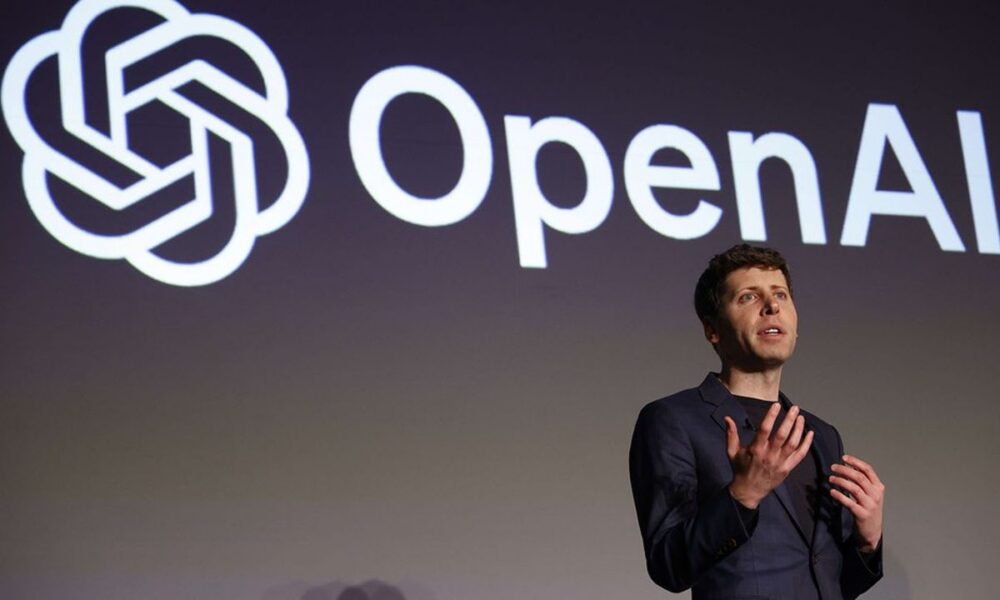
The OpenAI's record fundraising at $110 billion propels the company to a valuation of $730 billion, redefining the scale of private funding in artificial intelligence. Never before has a non-publicly traded company attracted such a large amount of capital in a single operation.
An extraordinary funding round
On February 27, 2026, OpenAI officially announced it had completed a first round of funding of $110 billion, distributed among three tech giants. Amazon contributes $50 billion, while Nvidia and SoftBank each bring $30 billion. The pre-money valuation is set at $730 billion, which will bring the company's total capitalization to $840 billion once all funds are injected.
To put this operation into context: less than a year ago, in March 2025, OpenAI had already set a historic precedent by raising $40 billion at a $300 billion valuation. In less than twelve months, Sam Altman's company has therefore more than doubled its estimated value. The round remains open, and OpenAI has indicated it expects to welcome new investors in the coming weeks.
Amazon: the key partner seeking exclusivity
Amazon's participation is the most structuring aspect of the operation. The $50 billion invested are not just a simple financial stake: they are accompanied by a deep technological partnership that repositions AWS at the heart of OpenAI's infrastructure. OpenAI commits to consuming 2 gigawatts of computing power provided by Amazon's Trainium chips, a in-house alternative to Nvidia GPUs, whose fourth generation is expected in 2027.
Even more notably, the two companies will co-develop a "stateful runtime environment," a persistent execution environment that will allow OpenAI's models to run natively on Amazon's Bedrock platform. "We have many developers and businesses who want to run services powered by OpenAI models on AWS," said Andy Jassy, CEO of Amazon, according to TechCrunch. This agreement extends a $38 billion commitment in cloud services announced as early as last November, for a total committed of $138 billion on the AWS side.
Nvidia invests and secures its own market
Nvidia's $30 billion investment was expected, but its final form had been the subject of intense speculation in recent months. In September 2025, reports mentioned an investment intention of up to $100 billion, before the figures were revised downwards. Jensen Huang put an end to rumors of disengagement in January, stating: "We are going to invest a lot of money. I believe in OpenAI. The work they are doing is incredible," according to TechCrunch.
In return for this investment, OpenAI commits to deploying 3 gigawatts of dedicated inference capacity and 2 gigawatts of training on Nvidia's Vera Rubin systems. The Vera Rubin platform, announced for partial commissioning in the second half of 2026, combines an 88-core ARM central processor called "Vera" and a "Rubin" GPU connected via NVLink with 1.8 TB/s of bandwidth. In its most powerful configuration, known as Rubin Ultra, each rack could deliver 8 exaflops of AI computing power.
SoftBank and Masayoshi Son's strategy
SoftBank, the Japanese conglomerate led by Masayoshi Son, completes this trio with a $30 billion contribution. This investment is in addition to the $40 billion already committed in the March 2025 round, bringing SoftBank's total exposure in OpenAI to a cumulative $70 billion. This is a massive bet on OpenAI's sustained dominance in the generative AI sector, at a time when direct rival Anthropic itself raised $30 billion in February 2026.
Growth financed on credit, profitability in sight
Behind the euphoria of the figures lie financial realities that investors cannot ignore. OpenAI expects to burn through $218 billion in cash by 2029, in a business model that remains largely deficitary in the short term. Its revenue, estimated at $13 billion in 2025, is expected to reach $20 billion in 2026, but cumulative losses are expected to be around $44 billion between 2023 and the end of 2028.
The projected trajectory, however, marks a turning point: OpenAI anticipates a first profit of $14 billion in 2029. It is precisely this projection that justifies, in the eyes of investors, valuations disconnected from current revenues. "We are pushing the boundaries of infrastructure, research, and products to achieve more powerful, reliable, and useful AI," said Sam Altman, CEO of OpenAI, in the official press release, according to Challenges.
Amazon's condition: a conditional billion
One detail deserves attention: according to The Information, $35 billion of Amazon's commitment is conditional. OpenAI confirmed the structure of this payment, only specifying that the additional $35 billion would arrive "in the coming months, when certain conditions are met," without detailing them. External sources had mentioned two possible scenarios: either the realization of an IPO, or the achievement of AGI (artificial general intelligence) by the end of the year, although OpenAI has not confirmed these specific conditions.
This fundraising marks a shift in how cutting-edge AI is financed: it is no longer traditional venture capital funds leading the rounds, but the hardware manufacturers and cloud providers themselves, who are transforming their investments into supply guarantees and exclusive commercial access. For players remaining outside this ecosystem, the question of access to computational resources becomes more pressing than ever.



No comments yet — start the discussion!