






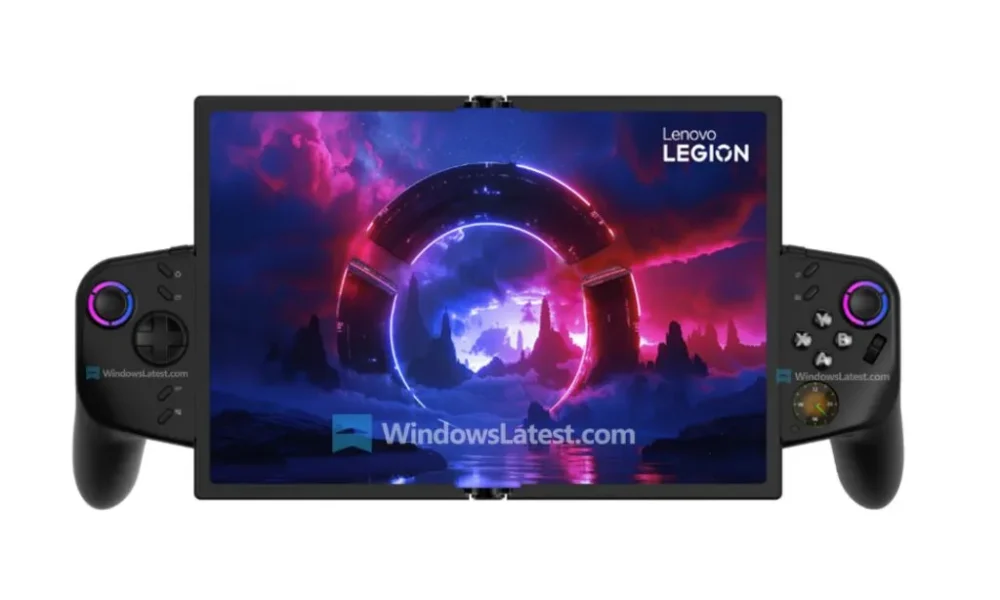
The Lenovo Legion Go Fold is perhaps the most ambitious portable console ever designed. A leak published on February 26, 2026, by Windows Latest reveals a device concept that transforms a classic Windows handheld into a large-format tablet, a desktop PC, or a laptop, depending on how it's configured.
A screen that changes everything
At the heart of the concept is a folding POLED screen which goes from 7.7 inches (the size of a standard portable console) to 11.6 inches when unfolded. This is a larger diagonal than that of the OneXPlayer X1 Pro, currently sold for around $1,400 on Amazon, which immediately places the Legion Go Fold in a category of its own. POLED technology guarantees deep blacks and reduced power consumption compared to an LCD screen, two particularly welcome qualities for a portable device of this ambition.
This hybrid format is not new in the smartphone world (the Galaxy Z Fold 7 comes close), but its application to a Windows gaming console is unprecedented. The screen is hinged in the center by a hinge, and its design allows for switching between four distinct usage modes without disassembling anything.
Four usage modes, one device
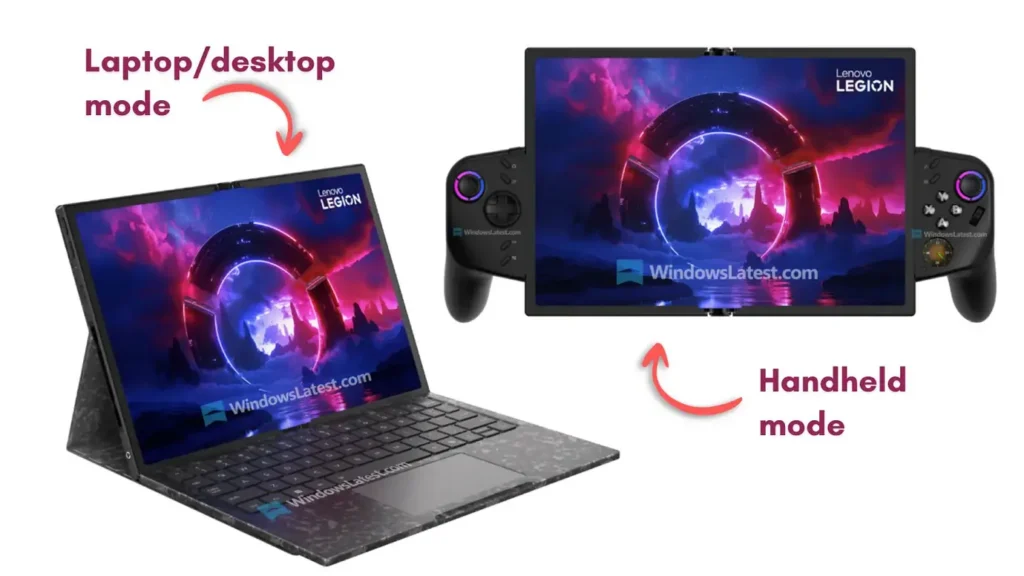
The versatility of the Legion Go Fold relies on four configurations that Lenovo has formalized in its concept.
| Mode | Description |
|---|---|
| Handheld Mode | 7.7" screen folded, wireless controllers attached on each side |
| Split-Screen Mode | Screen unfolded vertically, one half for gaming, the other for streaming |
| Horizon Full Screen Mode | Screen unfolded horizontally to 11.6", controllers attached for a full-screen experience |
| Expanded Desktop Mode | Device placed on a supplied wireless keyboard with integrated touchpad, like a classic laptop |
In desktop mode, the right controller can transform into a vertical mouse, which Lenovo calls "FPS Mode," a feature already present on the Legion Go Gen 2. This same controller integrates a small secondary screen displaying performance metrics, settings, and customizable shortcuts.
Concept specs, with their limitations
On the technical side, the Legion Go Fold features a Intel Core Ultra 7 258V processor (Lunar Lake architecture), 32 GB of RAM, and a 48 Wh battery. These specifications, if confirmed, raise legitimate concerns within the PC gaming community. The Lunar Lake chip, released in late 2024, is starting to show its age compared to Panther Lake processors that Intel has already released, known for their better energy efficiency and more powerful integrated GPU.
The battery capacity is also being criticized. With only 48 Wh to power an 11.6-inch POLED screen and an x86 processor, gaming battery life risk of being seriously limited, noted the Reddit community dedicated to handhelds shortly after the leak. Lenovo has not provided any data on the device's thickness or its connectivity, two points that will remain unclear until an official announcement.
A concept, not yet a product
It is essential to remember: Lenovo itself designates this device as a "concept." According to Windows Latest, Lenovo is set to present the Legion Go Fold at the Mobile World Congress in Barcelona, scheduled for March 2, 2026, with no sale confirmed or even considered in the short term. There is no official launch date or information on the price, and the technical specifications could evolve significantly if the project were ever to result in a commercial product.
XDA Developers notes that there is a real possibility that the device will remain simply a technological demonstration prototype, without ever reaching the shelves. The history of the sector is full of concepts presented at trade shows that have never been commercialized. That said, Lenovo has already managed to transform experimental ideas into sold products, as demonstrated by the first generation of the Legion Go.
Lenovo facing a rapidly changing market
The market for Windows handheld gaming consoles has exploded since the success of Valve's Steam Deck in 2022. Lenovo, ASUS (with the ROG Ally), MSI, and OneXPlayer are now competing in a segment that practically did not exist five years ago. In this context, the Legion Go Fold does not seek to directly compete with its rivals on raw specs, but rather to offer a radically different experience.
The idea of a device that replaces a handheld console, a tablet, and a compact laptop at the same time is appealing on paper. It corresponds to a fundamental trend: users want to reduce the number of screens and devices they carry. If Lenovo manages to solve the issues of battery life and graphics power in a finalized version, the Legion Go Fold could redefine what is expected from a handheld gaming high-end device. The public's reaction at MWC Barcelona will provide an initial signal about the project's commercial viability.

No comments yet — start the discussion!