








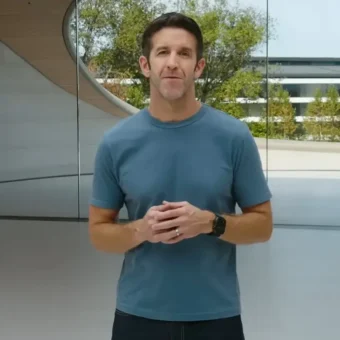
John Ternus becomes the next CEO of Apple as of September 1, 2026. This 51-year-old engineer, until now little known to the general public, succeeds Tim Cook after a 15-year reign.
Apple formalized this transition on April 20, 2026, in a press release published on its newsroom. The decision was unanimously approved by the board of directors, at the end of a succession planning process described as "long-term" by the company. Tim Cook is not disappearing, however: he will take on the role of Executive Chairman of the Board of Directors, succeeding Art Levinson in this position, and will continue to manage certain relationships with global policymakers.
25 Years at Apple, a Life Dedicated to Hardware
John Ternus joined Apple in 2001, 25 years before taking over the group's leadership. It was his second job after a stint at Virtual Research Systems, a virtual reality device manufacturer. He then joined the product design team and initially worked on components for Mac external displays, before contributing to iconic products like the iPod.
In 2013, he was appointed Vice President of Hardware Engineering, then promoted to SVP (Senior Vice President) in 2021, after replacing Dan Riccio, who had refocused on the augmented reality headset project that would become the Vision Pro. According to Apple's official leadership page, Ternus oversees all hardware teams, including the iPhone, iPad, Mac, and AirPods lines.
The Man Behind Apple Silicon and the Vision Pro
The most significant project of John Ternus 's career remains undoubtedly the transition to Apple Silicon, the historic migration of Macs from Intel processors to chips designed in-house by Apple. This decision, announced in 2020 and completed over two years, radically transformed Mac performance while reducing their energy consumption, and is today unanimously hailed as a technical and strategic success. He also led the development of the Vision Pro, the mixed reality headset launched in 2024.
More recently, Ternus oversaw the design of the MacBook Neo, a more accessible model that uses an iPhone chip to reduce manufacturing costs. "We never want to ship junk. We want to ship great products that have that Apple experience, that Apple quality. To do that with the Neo required building something completely new from the ground up, leveraging both the technologies we were developing, like Apple silicon, but also the expertise we have accumulated over many years of making Macs, phones, iPads, and many other things," John Ternus said in an interview with Tom's Guide. (We never want to ship junk. We want to ship great products that have that Apple experience, that Apple quality. To do that with the Neo required building something completely new from the ground up… leveraging both the technologies we’d been developing like Apple silicon, but also the kind of expertise that we’ve developed over many, many years of building Macs, and building phones, and building iPads, and all of these things.)
An Engineer's Profile, Between Rigor and Humility
At 51, Ternus is 15 years younger than Tim Cook, suggesting that Apple is seeking long-term leadership continuity. The Cupertino firm has had only two CEOs since the turn of the millennium, and this choice reflects a desire for stability that has always been displayed by the board of directors.
His character is revealed in an anecdote he himself told: during his first year at Apple, he found himself alone, late at night, in a supplier's factory, counting the grooves on screw heads with a magnifying glass to check their conformity. This obsessive attention to detail, inherited from the Steve Jobs culture, seems to have permanently shaped his vision of the profession. "He would move a piece of furniture, a chest of drawers, and pull it away from the wall to look at the back and reflect on the fact that the carpenter who made it had made it beautiful. He had finished the back as beautifully as the rest, even if no one was going to see it. And I think about that all the time, because I think it perfectly illustrates what we do here," said John Ternus about Steve Jobs, in an interview with TechCrunch. (Jobs was moving a piece of furniture, a chest of drawers, and pulled it away from the wall and looked at the back and was just reflecting on, you know, that the carpenter who made it had made it beautiful. It finished the back as beautifully as the rest of it, even though nobody was going to see it, right? And I think about that all the time because I think that perfectly exemplifies what we do here.)
In 2024, during his commencement speech at the University of Pennsylvania, an engineering school he himself graduated from, Ternus delivered what he considers his work philosophy: "Always assume you're as smart as anyone else in the room, but never assume that you know as much as they do," he stated during the ceremony. ("Always assume you're as smart as anyone else in the room, but never assume that you know as much as they do.") A rare message of humility in a sector often dominated by egos.
The Challenges Facing Apple's New Boss
Ternus's appointment comes at a particularly demanding time for Apple. The group is notably lagging in the race for artificial intelligence, a field where Google, Microsoft, and OpenAI have gained significant ground. The Vision Pro, a flagship product for the transition to spatial computing, has not yet found its mass market, and its commercial future remains uncertain.
Arthur Levinson, a board member, expressed his confidence in the new leader in Apple's official press release published on April 20, 2026: "We believe John is the best possible leader to succeed Tim and as he transitions to CEO, we know his love of Apple, his leadership, deep technical knowledge, and relentless focus on creating great products will help lead Apple to an extraordinary future." (We believe John is the best possible leader to succeed Tim and as he transitions to CEO we know his love of Apple, his leadership, deep technical knowledge, and relentless focus on creating great products will help lead Apple to an extraordinary future.)
Tim Cook, who will retain a strong institutional role as executive chairman, was the first to publicly endorse the choice of his successor, thus confirming a long-prepared transition rather than a sudden break. Until September 1, 2026, the two leaders will work closely together to ensure the continuity of ongoing projects. John Ternus inherits a company whose market capitalization is among the highest in the world, and whose next decisions in AI and hardware will define its trajectory for the coming decade.



No comments yet — start the discussion!