

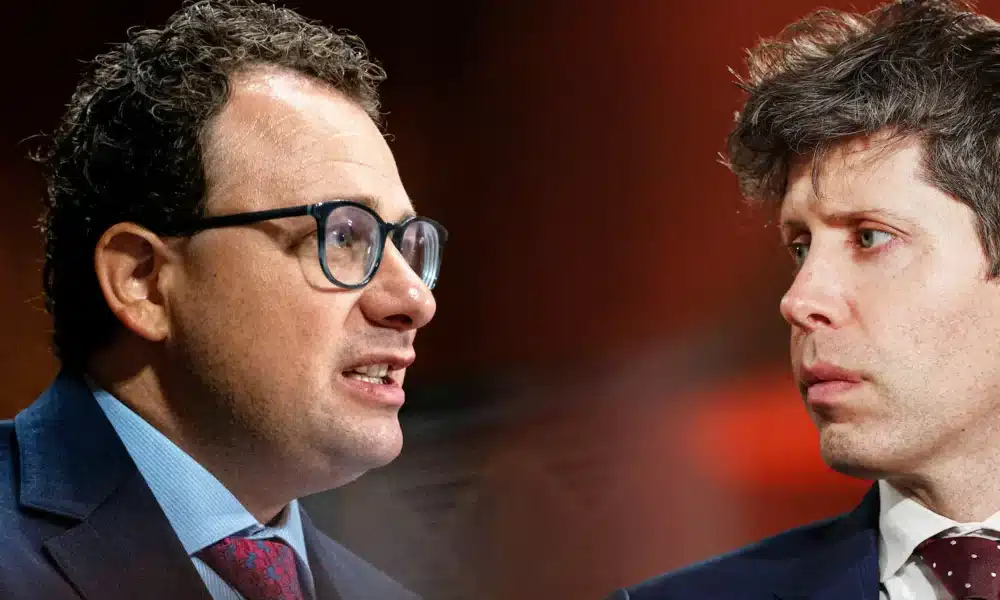
The scene was meant to symbolize the unity of the global artificial intelligence ecosystem. It became the most commented-upon image of the tech week. On February 19, 2026, during theIndia AI Impact Summit in New Delhi, Prime Minister Narendra Modi asked the leaders present on stage to hold hands and raise their arms in a sign of solidarity. Thirteen personalities, including Sundar Pichai and Jensen Huang, followed suit. Sam Altman and Dario Amodei, however, preferred to raise their fists on either side, ostentatiously ignoring each other.
New Delhi, global AI capital for a week
TheIndia AI Impact Summit 2026 is not an anecdotal event. This fourth edition brought together over 110 countries and about twenty heads of state, with a clear ambition: to position India as a central player in the next phase of AI deployment on a global scale. The country, long considered a mere talent pool for Western tech, now intends to have a say in strategic decisions and attract data center investments on its soil.
Tech giants were present, and not just for the photo op. OpenAI took advantage of the summit to announce the opening of two new offices in India, as well as a partnership with IT giant TCS to deploy 100 MW of data center capacity, with a long-term goal of one gigawatt. For its part, Anthropic opened an office in Bengaluru, appointed Irina Ghose as its general manager for India, and formalized an agreement with Infosys to integrate its Claude models into the Topaz platform, initially targeting telecommunications and financial services. India is indeed already Claude's second-largest market globally, with usage concentrated on technical tasks such as software development.
A rivalry that goes beyond ordinary competition
To understand why Altman and Amodei couldn't simulate a few seconds of unity in front of the world's cameras, we need to go back to 2021. Dario Amodei was then vice president of research at OpenAI, before slamming the door with his sister Daniela and several researchers to co-found Anthropic. The stated reason: deep disagreements over the company's strategic direction, and particularly over the priority given to safety in model development. Since then, the two companies have been in direct competition with ChatGPT on one side and Claude on the other hand, in the same market segments, the same enterprise clients, and the same cloud partners.
The nature of this competition, however, goes beyond a simple market share war. OpenAI, backed by Microsoft, embodies a model of rapid development, focused on commercial growth and massive product integration. Anthropic, valued at $380 billion after a $30 billion Series G funding round, positions itself as the responsible laboratory, placing AI safety at the center of its roadmap. These two visions are not simply different: they are ideologically competitive, and both CEOs are their public embodiments.
The Super Bowl as a declaration of war
If the New Delhi summit highlighted the tension, it was an advertising campaign broadcast during the Super Bowl 2026 that brought it to its public climax. Anthropic released four television spots directly targeting OpenAI, relying on confirmed plans to integrate advertising into ChatGPT. The closing message was identical in each spot: "Ads are coming to AI. But not to Claude." A positioning that the company presented as an unequivocal commitment, supported by a fundamental argument about preserving user trust.
The reaction from Sam Altman was not long in coming. On X, the CEO of OpenAI called Anthropic's approach "clearly dishonest" and added that the company "serves an expensive product to rich people." He then specified that OpenAI would never broadcast advertisements in the way described by Anthropic, believing that its users would "immediately reject" such a format. Greg Brockman, president of OpenAI, also spoke publicly to directly challenge Dario Amodei about his spots. The friction, until then essentially commercial, became personal and visible to the general public.
When actions speak louder than words
The refusal to hold hands in New Delhi is therefore not an isolated incident or a circumstantial gaffe. It is the physical translation of a fracture that now structures the entire AI sector. Modi had taken the hand of Pichai and Altman, placed on either side of him, before inviting the entire row to follow suit. When the gesture reached Altman and Amodei, the two leaders preferred to raise their fists separately rather than mimic a unity that neither felt. The video immediately circulated on X, commented on as much for its absurdity as for what it reveals.
This moment encapsulates in a few seconds the tensions shaking the industry: the question of advertisements in AI tools, the debate between commercial growth and priority to safety, and the personal rivalry between two leaders whose professional paths are intimately linked. TheIndia AI Impact Summit precisely aimed to send a signal of unity in the face of the global challenges posed by AI. Above all, it highlighted that the two most influential laboratories in the world in generative AI are no longer simply competing: they embody two incompatible development models, two opposing corporate cultures, and two visions of the future of artificial intelligence that will not converge anytime soon.
Sam Altman, during his speech at the summit, stated that superintelligence could be achieved within two years. Dario Amodei, for his part, did not publicly respond to this statement. But his refusal to raise his fist alongside Altman probably says more than any press release.

No comments yet — start the discussion!