






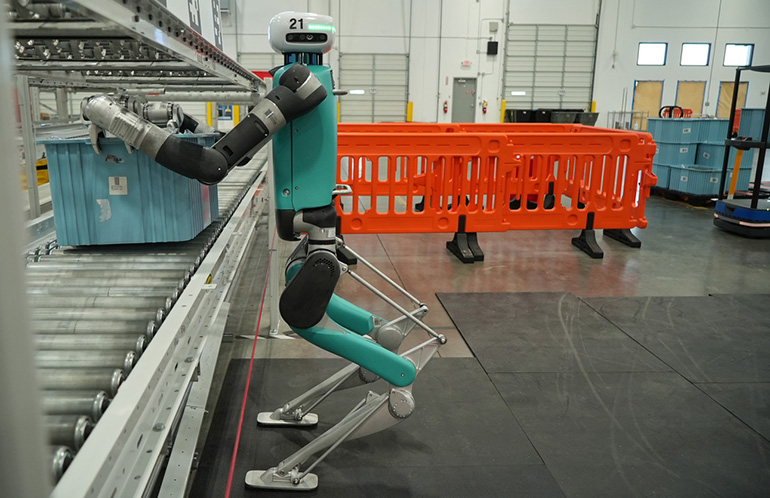
The automotive industry is reaching a concrete milestone with the announcement from Toyota Motor Manufacturing Canada: seven humanoid robots are now working at full capacity on the RAV4 production line in Woodstock, Ontario. Far from being a mere communication stunt, this deployment illustrates a profound transformation of factory work, made possible by technology that is finally emerging from laboratories to enter the real world.
Digit, a robot designed for industrial constraints
The robot deployed by Agility Robotics is called Digit. Developed in Salem, Oregon, by a company spun out of Oregon State University in 2015, this bipedal robot was not designed to impress with acrobatic demonstrations. Its design follows a single logic: to fit into an existing manufacturing environment without requiring facility restructuring.
In Woodstock, the seven units are assigned a specific task: unload bins of automotive parts unload bins of automotive parts from an automated cart (warehouse tugger) and transport them to the production line. This repetitive and physically demanding mission for human operators is exactly the type of task Digit was optimized for. Capable of handling loads up to 16 kilograms, it also integrates an artificial intelligence layer that allows it to adapt to different workflows without heavy reprogramming.
From experimentation to contractual commitment
The current deployment did not happen overnight. Toyota first conducted a one-year pilot project with three Digit units at its Woodstock site before signing a contract to increase the robot workforce to seven. This methodical progression is consistent with Toyota's production philosophy, known as the Toyota Production System (TPS): test, validate, then expand.
The commercial structure chosen is a robots-as-a-service model. Instead of purchasing the machines outright, TMMC subscribes to their use, which reduces the initial investment and allows for capacity adjustments based on operational needs. To manage the fleet, Agility Robotics provides its proprietary Arc software, a cloud platform dedicated to the supervision and maintenance of robots deployed at customer sites.
The real challenge: integration in real conditions
On paper, a humanoid robot capable of walking and grasping objects is impressive. In an active factory, it's another matter. Managing unforeseen events, charging and recharging batteries, preventive maintenance, and integration with other automated equipment are all obstacles that can only be overcome with a physical presence on site. Ram Devarajulu, Vice President at Cambridge Consultants, put it clearly at the Humanoids Summit in late 2025: "When tech companies really spend time on the ground understanding the real tasks and existing workflows, that's when we'll see massive adoption."
Pras Velagapudi, CTO of Agility Robotics, agrees. He acknowledges that deployment cost can exceed the purchase price of the robot itself, and that artificial intelligence is currently the central tool for reducing this cost and accelerating deployment. This is precisely the leverage Agility is activating through its expanded partnership with NVIDIA, which allows it to train and test Digit's behaviors in simulation environments before any physical deployment.
The automobile, a favorite playground for humanoids
Toyota is not the only manufacturer testing this technology in real conditions. Competition is active. Figure AI deployed its Figure 02 robots in a BMW factory for ten months, during which 90,000 parts were unloaded. For its part, Hyundai Motor Group announced an even more ambitious plan at CES 2026: 30,000 Atlas humanoid robots to deploy in its factories in Georgia and South Korea by 2030, with initial missions in parts sequencing starting in 2028.
Agility Robotics, for its part, is already working with major logistics players such as Amazon, GXO, and the Schaeffler group. Its valuation reached $1.8 billion in 2025, positioning it among the most serious firms in a rapidly consolidating sector. At CES 2026, Digit was among the few humanoid robots presented in effective industrial demonstrations, alongside Tesla Optimus, Figure 01, and UBTech Walker X.
Towards closer cohabitation with operators
The next step, already under development at Agility Robotics, concerns safety in a mixed environment. Current robots, powerful enough to handle heavy loads, are not yet certified to operate autonomously in the immediate vicinity of human workers. The next generation of Digit aims to overcome this limitation, paving the way for direct cohabitation on the assembly line.
TMMC and Agility Robotics have announced their intention to go beyond current logistics tasks to explore other use cases in Woodstock. Toyota's Canadian plant, which employs over 8,500 people and produces more than 500,000 vehicles annually, is thus becoming a full-scale laboratory for the automation of tomorrow. The question is no longer whether humanoid robots will enter automotive factories, but at what speed and under what conditions humans will continue to work alongside them.




No comments! Be the first one.