






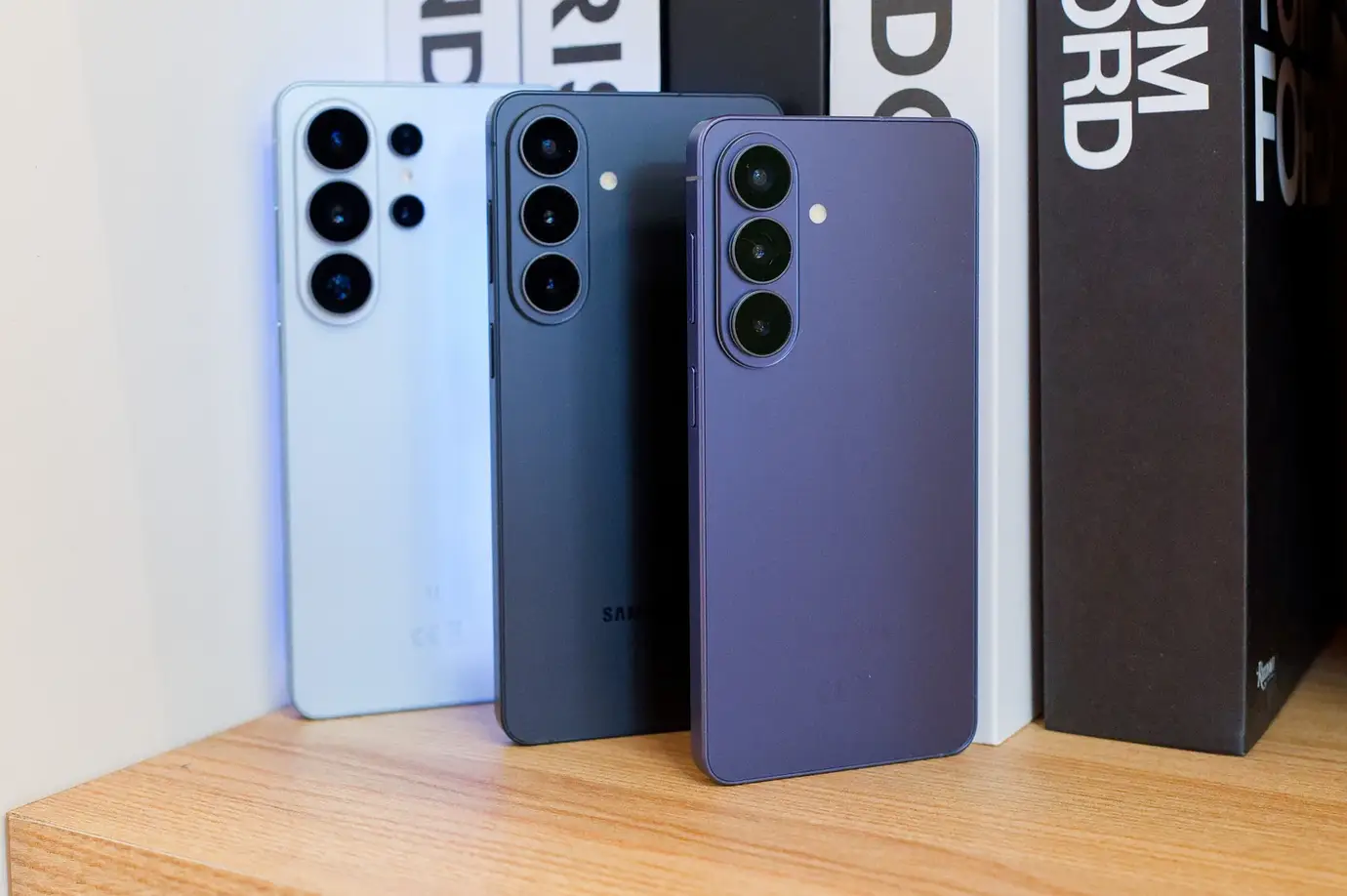
The series Samsung Galaxy S26 was officially unveiled during Galaxy Unpacked 2026. Three models, contrasting evolutions, and pricing choices that are making people frown: here's what you need to know before opening your wallet.
A range that plays the consistency card
For the first time, Samsung is visually aligning its three S26 models with a common design. The S26 and S26+ retain their usual Armor aluminum chassis with rounded corners, but the real change concerns theUltra, which abandons the angular corners inherited from the Note line in favor of curves similar to its two siblings. Samsung officially confirms this choice, justifying the unification by better ergonomics and overall consistency.
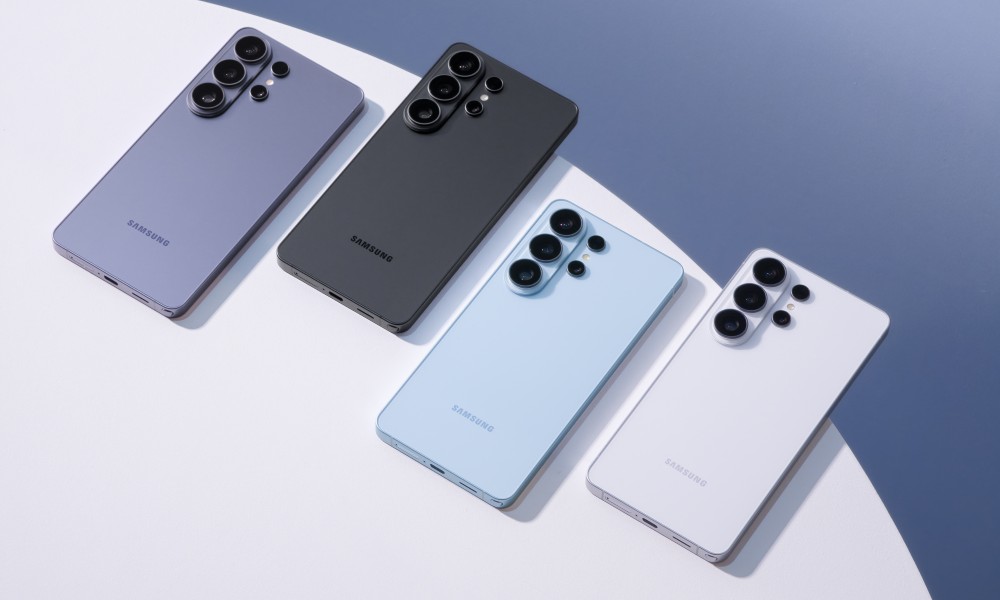
The four colors (black, purple, blue, white) are shared between the three models, with two exclusive shades available only on Samsung.com . This visual homogenization is deliberate: Samsung is focusing on a strong range identity rather than the uniqueness of each model. A readable commercial strategy, but one that risks disappointing users who bought the Ultra precisely to stand out.
S26 and S26+: measured evolution
The standard Galaxy S26 features a 6.3-inch Full HD+ AMOLEDscreen, with an adaptive refresh rate of 120 Hz and a maximum brightness of 2,600 nits. Its big brother, the S26+, goes up to 6.7-inch QHD+ with the same display characteristics. Both models are IP68 certified and run on One UI 8.5 on Android 16.
On the photo side, both devices offer a 50 MP main module, a 12 MP ultra-wide angle, and a 10 MP telephoto lens with 3x optical zoom, with no notable evolution compared to the S25 generation. The real progress is in battery life: the S26 gains 300 mAh with a battery increased to 4,300 mAh, while the S26+ retains its 4,900 mAh. Wired charging nevertheless remains capped at 25 W for the S26 and 45 W for the S26+, an obvious lag compared to Chinese competitors who commonly offer 80 W or 120 W.
S26 Ultra: calculated disruption
TheUltra concentrates the most structural changes of the range. In addition to the already mentioned rounded corners, Samsung returns to reinforced aluminum after two generations in titanium, citing better heat dissipation. The result is a thinner device than ever, at 7.9 mm for 214 grams, the thinnest Galaxy Ultra ever made. The screen measures 6.9-inch QHD+ Dynamic AMOLED, with an anti-reflective coating that should significantly improve readability in direct sunlight.
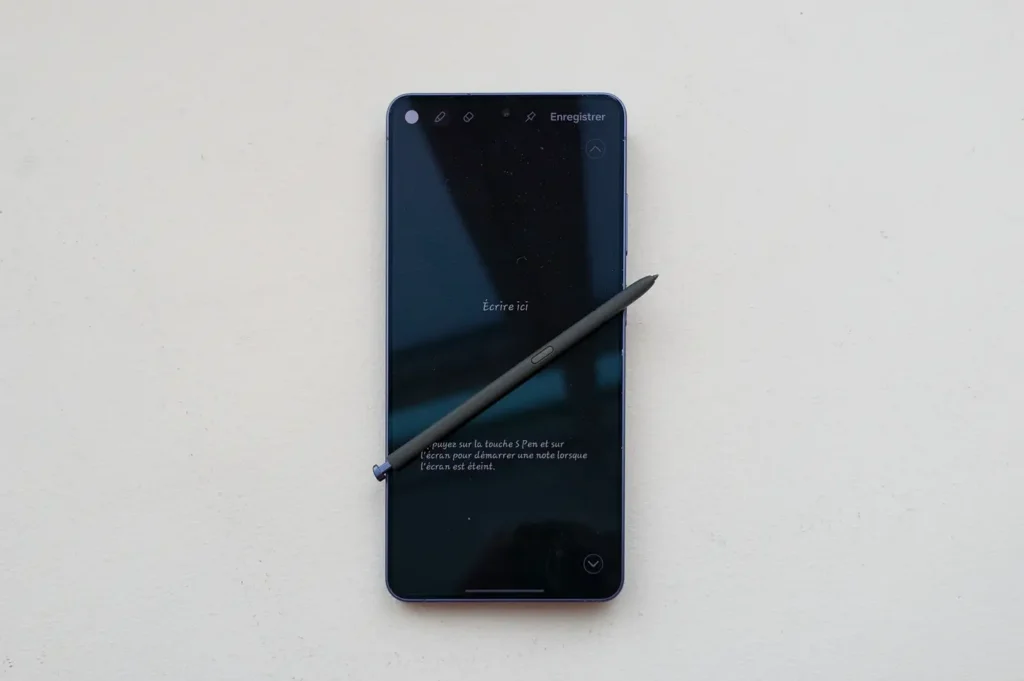
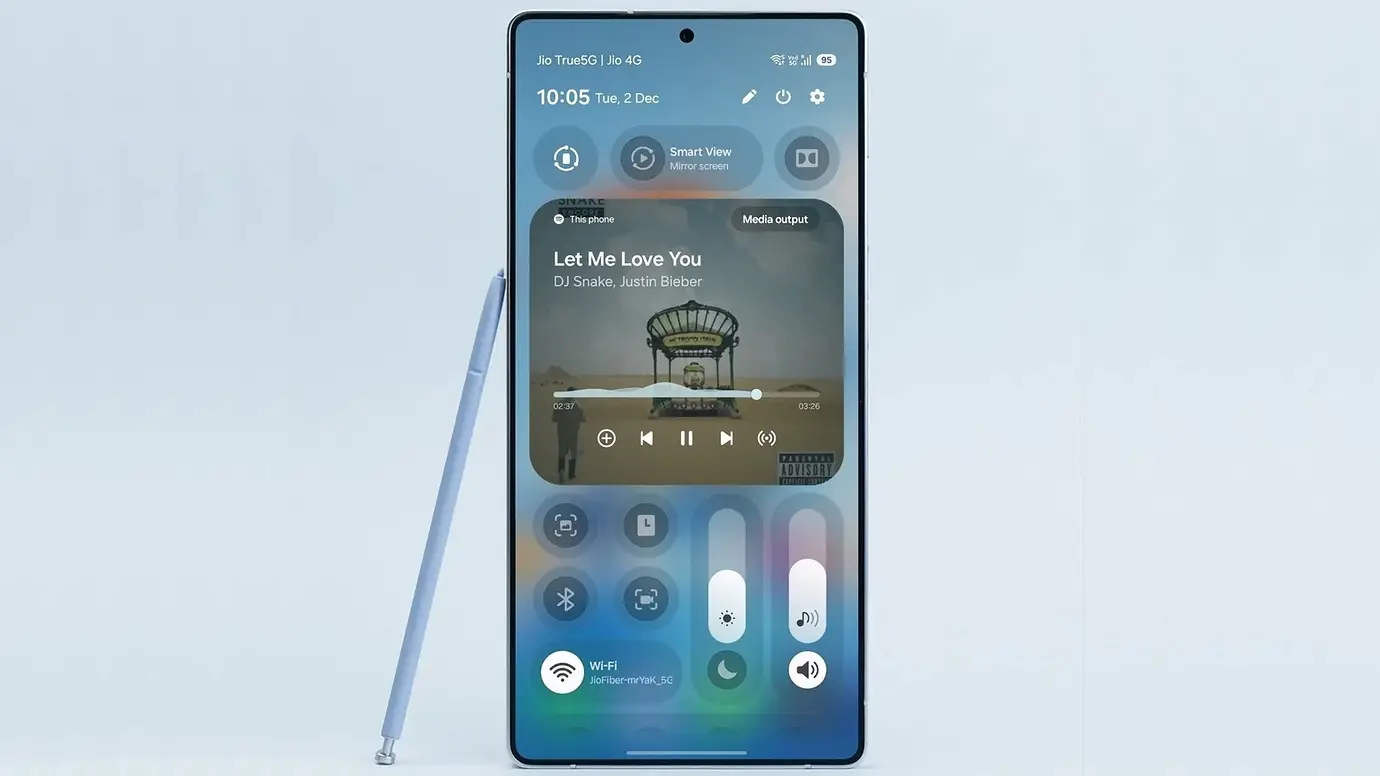
The S Pen pays the price for this transformation. Samsung has officially removed the S Pen's Bluetooth functions: no more remote camera triggering or Air Actions gestures. Its asymmetrical tip now requires it to be inserted in the correct orientation, a constraint directly linked to the new chassis geometry. The S Pen is only available in black or white, regardless of the phone's color. These are concrete functional setbacks for users who fully utilized these features.
Photography: the Ultra justifies its price
It's in photography that the Ultra widens the gap. Its main sensor of 200 MP goes from an f/1.7 aperture to f/1.4, or 47% more light according to Samsung. The 50 MP telephoto lens with 5x zoom also gains brightness, going from f/3.4 to f/2.9, with a reported gain of 37%. These are manufacturer figures that will need to be confirmed in real-world conditions, but the progress on paper is substantial.
Two new video features exclusively enhance the Ultra: the codec AV422 HQ for cinematic recording with log and HDR modes, and Horizontal Lock, which automatically stabilizes the horizon line during moving shots. Stabilization is also available on the S26 and S26+, but the professional codec remains an Ultra exclusive, widening the gap between the high-end model and its two siblings.
Exynos 2600 vs Snapdragon 8 Elite Gen 5: the European divide
The chip strategy confirms a now-usual dichotomy. In Europe, the S26 and S26+ feature theExynos 2600, Samsung's first SoC manufactured on a 2-nanometer process, which boasts announced gains of 5% in performance and 8% in energy efficiency compared to the Exynos 2500. The Ultra, meanwhile, receives the Snapdragon 8 Elite Gen 5 in its overclocked 'for Galaxy' version at 4.74 GHz, exclusively for this model worldwide.
Preliminary benchmarks show a close race between the two chips: the Snapdragon would retain a slight advantage in single-core, while the Exynos 2600 and its Xclipse 960 seem competitive or even slightly superior in GPU tasks according to some leaks. However, the Exynos has a reputation for overheating under prolonged load, which these spot benchmarks do not yet rule out. Long-term endurance tests will be decisive.
Galaxy AI: useful but unclear on billing
Across the entire range, Samsung introduces Now Nudge, a contextual AI feature that analyzes ongoing conversations and suggests relevant actions directly from the keyboard: opening a mentioned photo, checking a calendar slot, pre-filling a form. A phone scam detection system is also deployed on all three models.
The Agentic function, which allows complex tasks to be delegated to the assistant, is available in English and Korean at launch. The French support is not confirmed for the start. More concerning: Samsung had announced Galaxy AI features would be free until the end of 2025. When asked about the situation in 2026, the manufacturer reportedly stated that basic functions would remain accessible, but that paid premium offers could emerge, without officially confirming it according to Clubic. This opacity is difficult to ignore for a purchase at this price point.
Prices, pre-orders, and launch offer
Sales begin on March 11, 2026. Pre-orders are open until this date, with a launch offer allowing for double the storage capacity at no extra cost. Samsung also offers a €200 discount on the S26 and S26+, bringing the former down to €799 and the latter to €1,069 during the pre-order period.
Here are the official prices in France:
Galaxy S26: €999 (256GB) / €1,199 (512GB)
Galaxy S26+: €1,269 (256GB) / €1,469 (512GB)
Galaxy S26 Ultra: €1,469 (256GB) / €1,669 (512GB) / €1,969 (1TB)
Prices have increased across the entire range compared to the S25 series, with the exception of the S26 Ultra in 256GB, whose price remains stable. The discontinuation of the 128GB S26 at €899 further accentuates this impression of a range moving up in price without necessarily offering proportional value on the entry-level models.
The Galaxy S26 series presents a mixed assessment: solid photographic gains on the Ultra, a unified design that simplifies the range but erases the uniqueness of the flagship model, and an S Pen stripped of its most original functions. For S25 Ultra users satisfied with their right angles and Bluetooth stylus, the upgrade is far from obvious. For those coming from an older generation or looking for their first Ultra, the advances in photography and chassis refinement may be enough to justify the investment, provided the Exynos 2600 holds up over time in European markets.


No comments! Be the first one.