






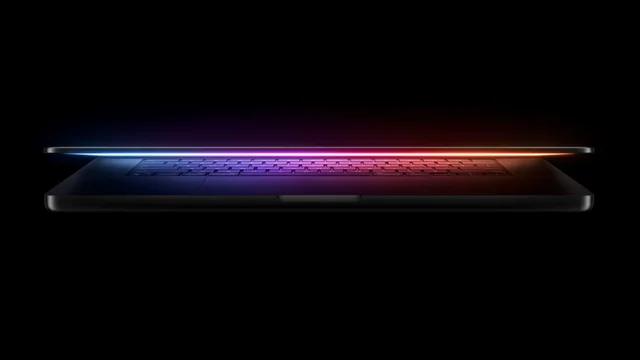
Apple is preparing to take a historic step with a OLED Touchscreen MacBook Pro integrating the iPhone's Dynamic Island. According to a Bloomberg report published on February 24, 2026, the launch is scheduled for autumn, marking the end of two decades of resistance to touchscreens on Macs.
Dynamic Island arrives on Mac
The notch that has topped MacBook Pro screens for several years will give way to a compact circular cutout, around which the Dynamic Island will come to life. As on the iPhone, this interactive space will expand contextually depending on the application or macOS functionality used: notifications, timers, live sports, system alerts. Mark Gurman of Bloomberg specifies, however, that the Mac's Dynamic Island will be smaller than that of current iPhone models, and that Face ID will not be included in this first version.
The Dynamic Island thus replaces the notch by freeing up more screen space for content, according to sources close to the matter cited by Bloomberg. Apple is also expected to offer this functionality in a reduced form on the iPhone 18 and iPhone 18 Pro, confirming an accelerated convergence between its mobile and desktop lines.
A macOS interface designed for touch... and the trackpad
Apple is not turning the MacBook Pro into an iPad. The stated goal is to offer touch as optional layer, overlaid on the existing keyboard and trackpad experience, without ever supplanting it. This philosophy translates into four adaptive behaviors described by Gurman.
When a user touches the screen, a circular contextual menu appears around the point of contact to offer commands adapted to the gesture. The menu bar automatically expands on hover to facilitate finger selection, and controls adjust based on previous interactions, whether touch or trackpad. Common gestures already present on iPhone and iPad, such as pinch-to-zoom or swipe scrolling, will also be supported.
This software transition is not improvised. The interface Liquid Glass introduced with macOS Tahoe last year already constituted a discreet preparation of macOS for touch: more spaced-out icons, new notifications, and control center sliders visibly calibrated for finger use. What looked like an aesthetic evolution was in reality a technical foundation laid in advance.
OLED screen, a generational change
The transition from mini-LED toTandem OLED screen is one of the most anticipated evolutions for professional users. This technology, already adopted by Dell and ASUS in their own ranges, promises absolute blacks (OLED pixels can turn off individually), more vibrant colors, and reduced power consumption for better battery life. The chassis would also benefit from a thinner profile thanks to the thinner display panel.
According to information reported by The Elec, Samsung Display has already begun production of the panels intended for these MacBooks, although component delivery delays were reported in early 2026. The OLED screen would be reserved exclusively for the M6 Pro and M6 Max, models with the standard M6 chip retaining an LCD screen, which could allow Apple to maintain a more accessible entry-level price point.
The M6 chip, first 2nm etching
Under the hood, these MacBook Pros would mark the arrival of the M6 generation, manufactured for the first time using the TSMC's 2nmprocess. This advancement promises a significant leap in performance per watt, necessary to handle the new computational loads related to embedded artificial intelligence and high-resolution OLED screens. It is the combination of this increased power and the new display features that, according to several analysts, justifies the likely increase in the starting price beyond 2,000 euros.
| Feature | Current MacBook Pro (M5) | Upcoming MacBook Pro (M6) |
|---|---|---|
| Chip | M5 Pro / M5 Max | M6 Pro / M6 Max (2 nm) |
| Display | Mini-LED | Tandem OLED |
| Camera | Notch | Dynamic Island (hole-punch) |
| Tactile | No | Yes (optional layer) |
| Sizes | 14 and 16 inches | 14 and 16 inches |
| Expected launch | 2025 | Q4 2026 (Oct-Nov) |
Steve Jobs said no. Apple says yes.
Apple's resistance to touchscreens on Macs is rooted in its history. During an event in October 2010, Steve Jobs called laptop touchscreens an "ergonomic disaster," fearing the fatigue generated by raised arms. In 2021, John Ternus, Apple's hardware chief, reiterated that the iPad remained the "best touch computer" and that he saw no reason to change this logic.
Market pressure has finally overcome this stance. With Windows touch PCs gaining maturity and Apple's application ecosystem now covering iPhone, iPad, and Mac with the same frameworks, the technical and commercial conditions for this shift were met. The first indications of a change of course had indeed been reported by Gurman as early as 2023.
These OLED touch MacBook Pros will not be presented at Apple's March 4th event, according to Bloomberg, but are expected between October and November 2026. For professionals waiting for a decisive reason to update their machines, the combination of OLED, touch, Dynamic Island, and the 2nm M6 chip undoubtedly represents the most compelling argument since the arrival of the M1 chip in 2020. It remains to be seen whether the launch price will confirm or temper this enthusiasm.

No comments! Be the first one.