








There's a truth you understand within the first few minutes spent in an Amazon warehouse: it's not a factory, it's a brain. A silicon brain that processes thousands of variables every second, from a customer's address to a robot's workload, including the probability that a sponge will be ordered with a children's book. Everything that resembles logistics is, in reality, artificial intelligence applied to mechanics.
The documentary broadcast by RMC Découverte on February 10, 2026, filmed in particular at the Augny site near Metz, dives for over an hour into what Jeff Bezos' company euphemistically calls its "distribution centers." Three out of four French people have placed at least one online order in the last twelve months. And behind every package that rings a doorbell, there is an industrial architecture of dizzying complexity.
The "moving forest": 4,000 robots, 30 million items
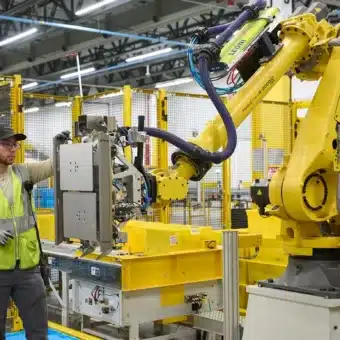
The Augny site, 11 km south of Metz, is Amazon's largest distribution center in France. Four levels, 182,000 m², and one golden rule: products come to humans, never the other way around. Nearly 4,000 autonomous robots, each weighing over 130 kg, transport 700 kg shelves at speeds of up to 17 km/h in certain aisles. As a result, the site can store up to 30 million items, which is 40% more than a warehouse of comparable size.
The robotic zone, which the teams nickname the "moving forest," is a labyrinth of 16,000 shelves per floor, all in perpetual motion. An employee entering it must pass a preliminary orientation test, put on a connected vest, and program a route: within a 12-meter radius, robots slow down; at 6 meters, they stop. Interventions to retrieve a fallen item or a malfunctioning robot number 150 per day per floor.
The "chaotic" storage: the discreet revolution born from Harry Potter
Amazon's great intellectual leap is not a robot. It's an apparently absurd idea: store items randomly. Shampoo is next to an HDMI cable, pasta shares a bin with a recipe book. This random, "chaotic" storage is managed by an algorithm that analyzes the probabilities of joint orders between products, thus optimizing density and picking speed.
This method was born from an incident that has since become legendary. In the early 2000s, when a certain novel about a young English wizard was released, Amazon warehouses, traditionally organized by category, were paralyzed: too many pickers were crowding the same "literature" section. Since then, the algorithm no longer sorts by category but by order probability and size, a logic applicable in both robotic and traditional warehouses.
AWS, the invisible conductor
Behind all this machinery, it's Amazon Web Services who holds the reins. The cloud infrastructure drives real-time flows: stock location, carrier availability, delivery time forecasting, robot energy management. To promise next-day delivery, the system analyzes "several hundred different parameters" simultaneously, from the customer's address to the warehouse load.
AI doesn't stop at orders. It also monitors machines. Proprietary sensors called Monitrons, developed in-house by Amazon, measure temperature and vibrations on fixed equipment every hour, allowing potential breakdowns to be anticipated two weeks in advance. For conveyors, thermal cameras film continuously, triggering an alert as soon as a belt reaches 35 or 40°C depending on the technology type. Over 23 km of conveyors, even a minor stoppage can paralyze the entire logistics chain.
The Vercelli Laboratory and Smart Pack
Amazon doesn't just use existing technologies: the group creates them. In Vercelli, in the Italian Piedmont, a 6,000 m² European laboratory designs the robots of the future, alongside two other laboratories in Boston and Seattle. It is here that the Smart Pack was developed. This machine automatically packages individual items at a rate of 500 packages per hour, in a 100% recyclable paper bag, without glue or chemicals, simply by applying pressure and heat.
Each package produced this way weighs 26 grams less than standard packaging. On the scale of billions of annual packages, the impact on transport costs and carbon footprint is significant. A 2.0 version of the labeling machine, still in the testing phase in Vercelli, goes further: it identifies the flat area of a package using a camera and AI, regardless of its shape, and applies a label of appropriate size, eliminating the need for additional overpackaging. Over the past 5 years, Amazon has invested 750 million euros in Europe in these technological developments.
The last mile: a secret algorithm "like the Coca-Cola recipe"
The chain does not stop at the shipping docks. In Villeneuve-la-Garenne, in the Paris region, a delivery agency receives about twenty trucks every night between 5 PM and 7 AM. The packages are sorted there, again automatically via a system called "the Matrix," before being distributed into bags corresponding to specific geographical areas.
350 subcontractor vans arrive in waves of 20 minutes in the parking lot. Each driver receives a route entirely calculated by a machine learning algorithm, which Amazon managers describe as "our Coca-Cola recipe." Optimized for safety, feasibility, and efficiency, this algorithm remains strictly confidential. It even plans the loading order of the bags into the vehicle: the first loaded is the last delivered.
Amazon in France: an expansion that doesn't stop
The French network now has 8 large logistics sites and more than 35 delivery agencies. Three of them are fully automated: Brétigny-sur-Orge (opened in 2019), Augny-Metz (2021), and Boves, in the Somme region, inaugurated in October 2025 after an investment of 110 million euros. The latter holds an unusual record: Amazon's largest global robotic surface area on a single level, with 20,000 mobile shelves and over 2,000 robots.
A fourth automated site is currently under construction in Colombier-Saugnieu, near Lyon, on 21 hectares, with a surface area of 160,000 m² over three levels. Ultimately, if we extrapolate from the group's American plans, where Amazon intends toautomate 75% of its operations and replace up to 600,000 jobs by 2033, the question of the balance between employment and robotization will become increasingly pressing in France. For now, Amazon continues to assert that robotization goes hand in hand with net job creation. French data seems to support this in the short term. The future remains open.


No comments yet — start the discussion!