






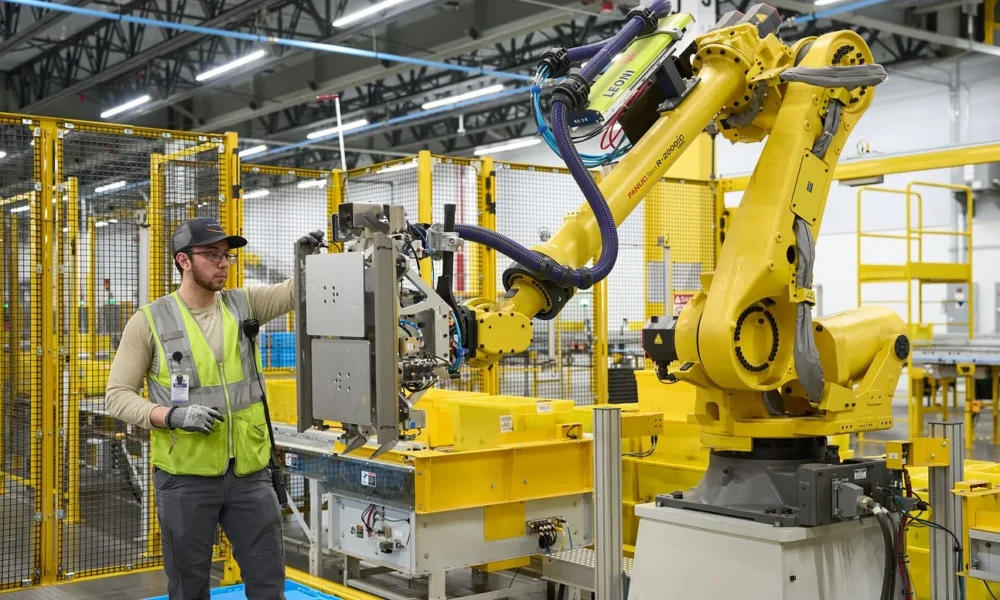
Amazon had presented Blue Jay in October 2025 as a key technology for its same-day delivery warehouses. A few months later, in January 2026, the project was silently buried. A rapid abandonment that illustrates, once again, the limits of artificial intelligence when faced with the very concrete constraints of the physical world.
When AI hits reality
Blue Jay was presented as a multi-arm system designed to accelerate order preparation in rapid delivery centers. Its development, carried out in record time thanks to AI advancements, was intended to allow Amazon to improve productivity while enhancing the safety of its employees. The project was in a pilot phase in a South Carolina warehouse at the time of its public announcement.
Internally, reality quickly contradicted the promises. According to sources cited by Business Insider, the project encountered three roadblocks: high manufacturing costs manufacturing costs, a complex technical architecture, and integration difficulties in existing warehouses. AI has certainly accelerated design, but it has not resolved physical constraints where every robotic action must remain reliable, fast, and above all profitable.
Amazon is downplaying the scope of this halt and refers to it as an experimental prototype. Terrence Clark, a company spokesperson, told Business Insider that the technology developed in Blue Jay will be reused in other programs across the warehouse network. Many employees assigned to the project have also been reassigned to other robotics initiatives.
An already dense robotic ecosystem
The abandonment of Blue Jay does not mean Amazon is backing down on automation. The group has surpassed the milestone of one million robots in its warehouses worldwide. Its fleet includes a wide variety of machines: Proteus, an autonomous mobile robot capable of operating alongside employees, Sparrow, specialized in picking individual items, and Robin, dedicated to sorting packages.
Vulcan, presented in May 2025, remains the most advanced robot in the current catalog. This robotic arm can manipulate products in storage compartments while "feeling" contact thanks to haptic sensors. It is this direction, based on sensory precision rather than multiplying arms, that seems to guide Amazon's technical strategy. Amazon has also deployed an internal AI model called DeepFleet to improve the coordination of its entire robotic fleet.
Orbital, the modular architecture that will succeed
To replace Blue Jay, Amazon is working on a system called Orbital. Unlike its predecessor, Orbital relies on a modular architecture: several automated components can be assembled according to the specific configuration of each warehouse, directly addressing the deployment costs and integration issues that torpedoed Blue Jay.
Orbital's main target is the network of same-day delivery, notably the compact warehouses associated with Whole Foods stores in the United States. Amazon is thus seeking to automate small-scale sites where its large, fully robotic facilities cannot be duplicated. The first warehouse built around Orbital is not expected before 2027, however, underscoring the scale of the remaining work.
This transition confirms a hard-learned industrial lesson: in physical robotics, adaptability and modularity take precedence over raw technical sophistication. A robot that is impressive on paper but impossible to deploy on a large scale has no real industrial value.
Behind innovation, a strategy of massive replacement
The failure of Blue Jay is part of a much broader context. In October 2025, internal documents revealed by The New York Times showed that Amazon plans to hire no more than 600,000 people in the coming years, even if its sales double by 2033. The robotics department aims for 75% automation of its operations, with the explicit goal of reducing reliance on human labor at each new site.
The model warehouse in Shreveport, Louisiana, deploys about a thousand robots and has already reduced staff by 25% compared to a comparable non-automated site. Amazon plans to replicate this model in about forty warehouses and estimates saving about 30 cents per item processed thanks to automation, which represents billions of dollars globally.
The abandonment of Blue Jay is therefore not a renunciation of automation. It is a tactical adjustment in a much more radical strategy that is not pausing.



No comments! Be the first one.