






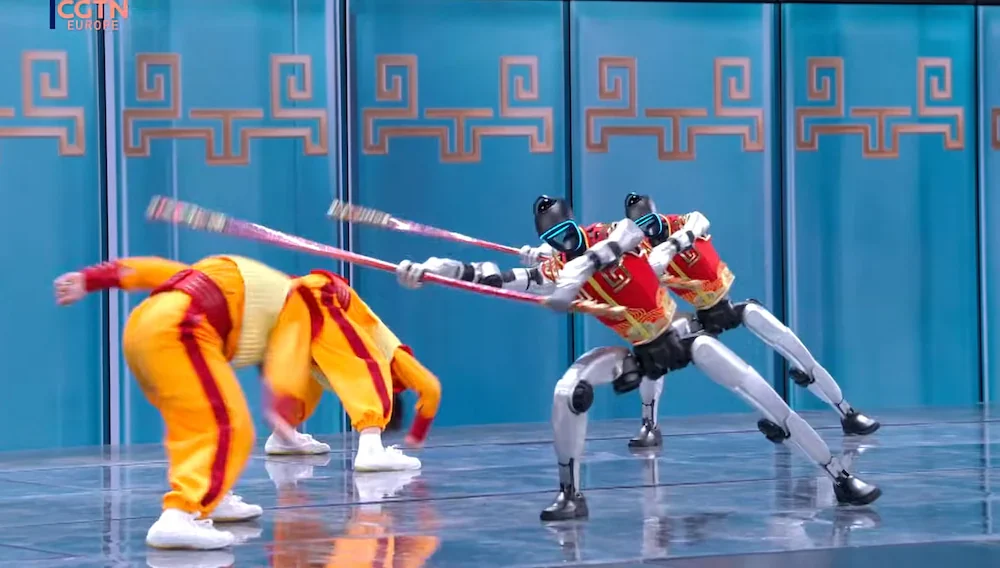
In front of nearly a billion viewers, Chinese humanoid robots performed an unprecedented kung fu show during the 2026 New Year's Gala. Somersaults, weapon handling, acrobatics: the demonstration far exceeded a simple cultural performance to become a major political and industrial signal.
The real challenge is not theatrical, it is strategic
We could have contented ourselves with admiring the show. That would be missing the point. On February 16, 2026, during the Spring Festival Gala broadcast live on CCTV, several dozen humanoid robots from the brand Unitree Robotics performed kung fu moves, wielded swords and staffs, executed jumps on trampolines, and somersaults at three meters high, all without any robots on the ground and without special effects, according to Reuters. The show is watched each year by 600 million to 1 billion viewers, making it the most powerful cultural showcase in the world. This year, it primarily served as a technological demonstration for the entire planet.
The Chinese Ambassador to the United States, Xie Feng, seized the opportunity with deliberate irony on X: "Remember the dancing robots from last year's Gala? This year, they've become kung fu masters!" This statement, more than any analysis, summarizes the rapid progress that Chinese engineers have managed to publicly display.
From synchronized dancing to martial arts: a technical evolution in 12 months
Unitree G1 robots performing kung fu with performers on Spring Festival Gala stage
The comparison with the previous edition is striking. In 2025, Unitree robots performed a simple dance waving handkerchiefs, a performance that was already noted but still limited. In 2026, the same machines are chaining complex movements: wall handstands, somersaults over obstacles, backward running, nunchaku handling.
Four companies were represented at this gala: Unitree Robotics, Noetix, MagicLab, and Galbot. But it was the robots Unitree's G1, based in Hangzhou, that captured attention thanks to the world's first fully autonomous cluster kung fu performance. The technical challenge behind this feat is considerable: synchronizing several almost identical robots, maintaining their balance on unstable supports, and managing micro-errors in real-time without the choreography collapsing. This relies as much on advanced motor control as on embedded dynamic balance algorithms.
This is not the first time Unitree has made waves on stage. In December 2025, its robots had already performed a synchronized choreography alongside human dancers during a concert by singer Wang Leehom. And a week before the CCTV gala, Shanghai-based startup AgiBot organized its own streaming show with over 200 humanoid robots, as if to warm up the crowd before the main event.
Behind the scenes, an industry that crushes the competition
The televised show is merely the visible face of an industrial dominance that is asserting itself month after month. According to Counterpoint Research, China accounted for over 80% of global humanoid robot installations in 2025, out of a total of 16,000 units delivered worldwide. Unitree alone reportedly shipped over 5,500 bipedal humanoid robots last year, according to the South China Morning Post, a figure unmatched by its American competitors.
Faced with this momentum, Tesla remains in the industrialization phase of its Optimus robot. Elon Musk has mentioned the construction of a production line capable of reaching one million units per year, but not before the end of 2026. In the meantime, Unitree is already delivering. Morgan Stanley anticipates around 28,000 humanoid sales in China as early as 2026, and the global humanoid robot market is expected to reach 100,000 units by 2027, a sixfold increase in two years. The global market is valued at $4.89 billion in 2025, with a rapid trajectory towards $6.24 billion in 2026.
Stage performances vs. industrial robots: the nuance that matters
However, it would be inaccurate to confuse choreographic feats with industrial maturity. Consultant Georg Stieler points out in The Guardian: stage performances rely on routines repeated hundreds of times in a perfectly controlled environment. Adapting to the unexpected, whether it's an obstacle, a terrain variation, or unscripted human interaction, remains the true benchmark for use in warehouses, factories, or homes.
China is aware of this. The Chinese government set the goal as early as 2023 of developing a complete supply chain for humanoid robots by 2025, a deadline it appears to have met. In August 2025, the World Humanoid Robot Games held in China had already highlighted this operational superiority: Unitree robots had won first place in the 4x100-meter relay in athletics. The strategy is clear: flood the market with robots, collect maximum real-world data, and iterate quickly. This is exactly the formula that allowed China to dominate the drone industry in a decade.




No comments! Be the first one.