






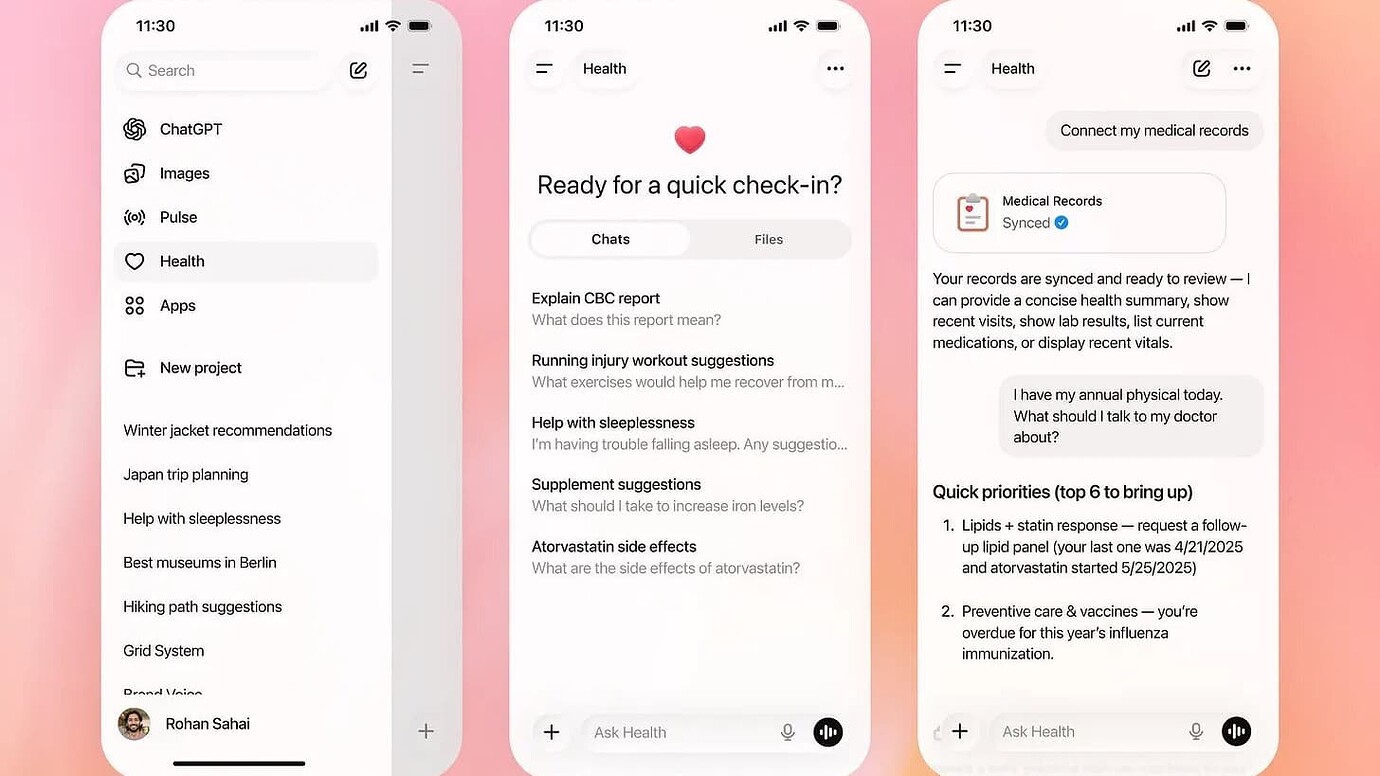
January 2026 will mark a decisive turning point in the history of consumer artificial intelligence. After months of speculation and strategic partnerships, OpenAI has officially launched ChatGPT Health (or ChatGPT Health), a dedicated and secure interface designed to transform our relationship with medical data. Far from being a mere gadget, this new feature aims to become a personal health assistant, capable of analyzing your blood tests or connecting to your fitness apps, all while navigating the ethical red line of digital medicine.
A dedicated interface at the heart of your vital data
The main novelty of ChatGPT Health lies not only in its ability to answer medical questions, but in its deep integration with your personal data. Unlike the standard version of ChatGPT which responded generically, this new version allows users to connect (via secure APIs) their electronic medical records as well as their wellness applications such as Apple Health, MyFitnessPal, or Oura.
Specifically, the user can now submit a PDF file of blood test results and ask: "Can you explain to me what my high ferritin level means in the context of my current fatigue?". The AI no longer just provides dictionary definitions; it cross-references these results with your physical activity history or sleep data (if you have authorized access to this data) to provide a contextualized answer.
This feature was developed in close collaboration with over 260 doctors across 60 countries and validated via the HealthBench, an internal evaluation tool created by OpenAI to ensure that responses meet clinical safety and clarity standards.
Confidentiality and Security: The Digital "Safe"
Aware that health is the most sensitive area for users, OpenAI has built ChatGPT Health as an isolated environment. The company insists that this is a 'isolated experience'.
This implies two major guarantees for the user:
- Data isolation: Medical documents, discussions about your symptoms, and data from your smartwatches are stored in a separate space. They are not mixed with your usual conversations about cooking or work.
- No training on your data: OpenAI has explicitly stated that the information shared in this health space is not used to train future models artificial intelligence. This is a direct response to legitimate concerns about privacy, ensuring that your symptoms will not be used to train the next version of GPT-5.
An assistant, not a doctor
Despite these impressive technological advances, OpenAI hammers home a message of caution: ChatGPT Health does not replace a doctor. The launch of this service comes after a strict update of the terms of use at the end of 2025, which limited the AI's ability to give 'actionable' medical advice without supervision.
The positioning is therefore one of support and 'medical literacy' (the ability to understand health information). The objective is to help the patient to:
- Prepare your consultations: By listing the relevant questions to ask the specialist.
- Demystify jargon: Translate complex hospital reports into clear language.
- Track your habits: Analyze long-term sleep or nutrition trends to suggest lifestyle adjustments.
A competitive strategic context
This launch is not out of nowhere. It follows the project Thrive AI Health, a joint venture previously announced with Thrive Global (Arianna Huffington's company), which already aimed to create an ultra-personalized health coach. With ChatGPT Health, OpenAI integrates this vision directly into its flagship product, making health accessible to its hundreds of millions of weekly users.
In conclusion, ChatGPT Health represents a major step towards more participatory medicine, where the patient is equipped with powerful tools to understand their own body. While the promise is appealing, the success of this tool will depend on the trust users place in OpenAI to keep their most intimate secrets well guarded.



No Comment! Be the first one.