







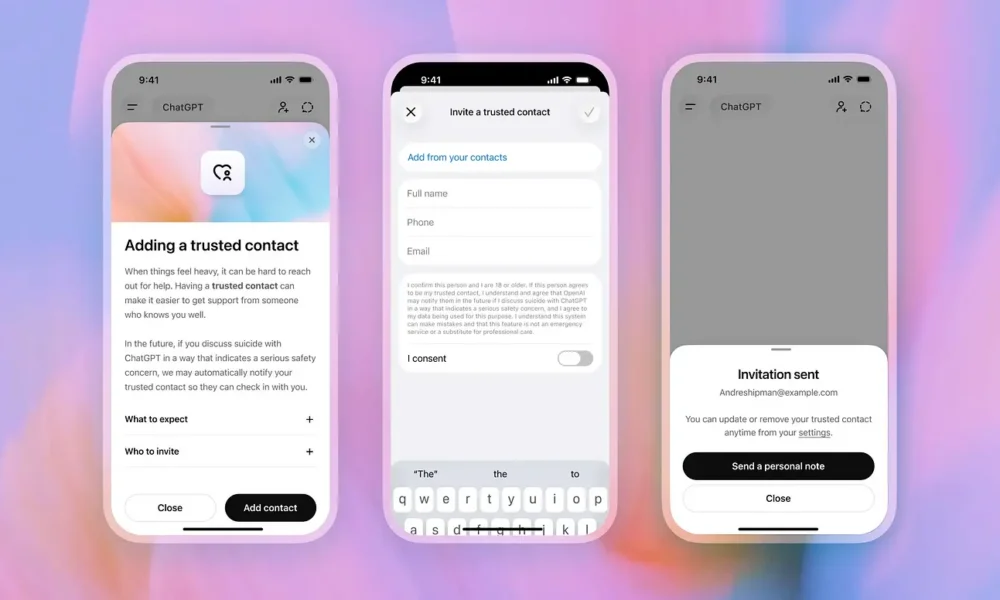
ChatGPT is integrating a new feature called Trusted Contact, designed to alert a loved one if a risk of suicide is detected in a conversation. OpenAI began this gradual rollout on May 7, 2026.
The announcement was made directly on OpenAI's official blog and marks a significant step in the company's safety strategy. This is not just a technical update; it's a direct response to criticisms, lawsuits, and human tragedies associated with ChatGPT's use during times of psychological distress.
Why OpenAI is acting now
The pressure on OpenAI is real and measurable. The company has faced several lawsuits filed by families whose loved ones died by suicide after conversations with ChatGPT. In some cases, plaintiffs alleged that the chatbot encouraged or even assisted these individuals in planning their actions.
Beyond litigation, OpenAI's own data paints a concerning picture. According to figures released by the company, 0.07% of its weekly users showed signs of mental health crises related to psychosis or mania, while 0.15% expressed a risk of suicide or self-harm. Another 0.15% showed signs of emotional dependency on the tool. Scaled to the announced reach of ChatGPT's audience (approximately 10% of the global population weekly, according to OpenAI), these percentages potentially represent several million people affected.
How Trusted Contact Works
The principle relies on voluntary designation. The user chooses a trusted person, a friend, a family member, or a caregiver, and sends them an invitation through their ChatGPT account settings. The designated person then receives a message clearly explaining the role they are asked to accept. They have one week to confirm or decline. If they decline, the user can choose someone else.
Here are the steps of the process once the feature is activated:
ChatGPT's automated systems analyze conversations and flag those that might indicate a serious risk of self-harm.
ChatGPT informs the user that their trusted contact may be notified.
A team of specially trained human reviewers evaluates the situation and decides if the case constitutes a serious safety risk.
If the reviewers confirm the severity, a brief notification is sent to the designated contact via email, SMS, or a notification within the ChatGPT app.
OpenAI specifies in its official announcement that the goal is to examine these situations within a one-hour timeframe. The feature is accessible to users aged 18 and over worldwide (19 and over in South Korea), exclusively via personal accounts.
Privacy, a Non-Negotiable Limit
The issue of privacy is central, and OpenAI has treated it as a design constraint, not an option. According to the company's official press release, the notifications sent to the trusted contact are intentionally limited: they include neither the details of the exchanges nor any conversation transcript.
The contact receives only general information indicating that a mention of self-harm has been detected in a potentially concerning context, along with an invitation to check on the user and a link to expert resources. This approach protects the user's privacy while allowing for rapid human intervention.
The user also retains full control: they can modify or delete their trusted contact at any time from their account settings. The designated contact can, in turn, remove themselves from this role via OpenAI's help center.
A Human Device, Not Just Algorithmic
What distinguishes this feature from a simple automatic filter is the systematic human intervention. OpenAI states in its announcement that automated systems are only used to detect candidate conversations. The final decision to send a notification always rests with trained human reviewers, not with an algorithm alone.
This architectural choice avoids a major risk: that of triggering unjustified alerts on conversations that discuss mental health in an informative, literary, or academic manner. The combination of automatic processing and human expertise is presented by OpenAI as a guarantee against false positives, even if the precise triggering criteria remain confidential.
Dr. Munmun De Choudhury, a professor at Georgia Tech and a member of OpenAI's Expert Council on Well-being and AI, expressed her support for the initiative in the company's official press release: "One of AI's biggest promises lies in its ability to foster authentic connection between human beings and psychological safety. I am encouraged by ChatGPT's Trusted Contact feature, which represents progress towards human empowerment, especially in moments of vulnerability." ("One of AI’s biggest promises is how it can foster authentic human-to-human connection and psychological safety. I am encouraged by ChatGPT’s Trusted Contact feature, which offers a step forward to human empowerment, especially during moments of vulnerability.")
What the Feature Does Not Replace
OpenAI is explicit about the limitations of the system. The Trusted Contact adds to existing protections without replacing them. ChatGPT continues to direct users to local helplines and emergency services when the situation warrants it. The feature is not available for business accounts, Enterprise workspaces, or Edu educational environments. It is strictly reserved for personal adult accounts.
The company also specifies that the rollout is gradual. As of May 8, 2026, not all eligible accounts have yet access to the feature. OpenAI has not communicated a precise timeline for full coverage.
The launch of Trusted Contact is part of a consistent trajectory. In September 2025, OpenAI had already introduced a parental notification system allowing parents to monitor their minor children's accounts and be alerted in case of detected risk. The new feature extends this safety net to adults who wish to use it. To activate Trusted Contact today, go to ChatGPT Settings, under the "Trusted contact" tab. Setup takes only a few minutes, but can make a decisive difference.





No comments yet — start the discussion!