






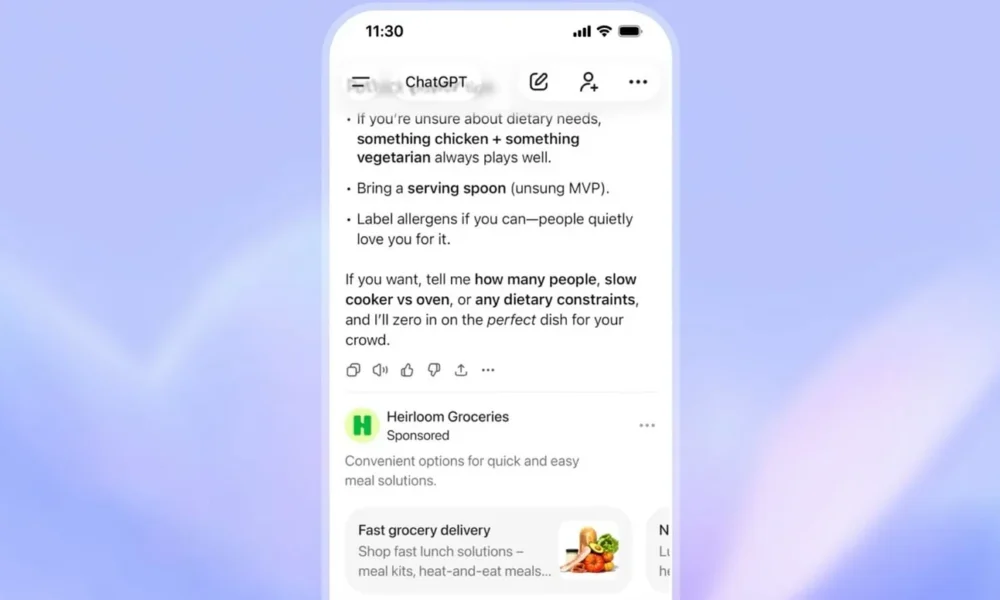
Since February 9, 2026, OpenAI has begun rolling out advertisements on its platform. This major change, which many observers feared, currently only affects users located in United States, but undoubtedly foreshadows a global rollout in the short term.
The ads now appear for two categories of users:
Users of the free version.
Subscribers to the new plan ChatGPT Go (a "low-cost" offer at $8/month).
Unlike traditional intrusive banners, OpenAI has opted for a relatively discreet integration. Ads are displayed at the bottom of the responses of the AI, are clearly labeled as "Sponsored," and remain visually separate from the content generated by the chatbot to avoid any confusion.
Contextual targeting that (partially) respects your privacy
One of the biggest fears regarding advertising in AI is the exploitation of personal data. On this point, OpenAI is trying to reassure with firm promises.
The company assures that the content of your conversations will not be shared with advertisers. Ad targeting is based on the immediate context of the discussion and your interaction history, but without transmitting your "memories" or raw data.
In concrete terms, if you ask for a Mexican recipe, the algorithm might display an ad for a hot sauce brand or a meal kit. OpenAI also insists that ads will never influence the responses of AI: brands can buy ad space, not the robot's "thoughts."
Why now? The economic reality
This decision is explained by a simple economic equation: AI is extremely expensive. With over 800 million weekly users , but only 5% to 10% of paying subscribers, OpenAI bears colossal infrastructure costs.
The introduction of advertising, coupled with the launch of the subscription ChatGPT Go (which offers more messages than the free version but retains ads), aims to monetize this huge base of "free" users who consume a lot of computing resources.
The model war: Claude counterattacks, Google hesitates
The arrival of advertising at the market leader has immediately created an ideological rift with its competitors.
Anthropic (Claude) is now positioning itself as the champion of "purity." The company took advantage of Super Bowl 2026 to broadcast a campaign mocking the omnipresence of advertising, reaffirming that its AI Claude would remain 100% ad-free.
Google (Gemini) is keeping things vague. While reports indicated in late 2025 that Google planned to integrate ads into its chatbot in 2026, the management officially denied the information, stating there were "no current plans" to change the ad-free model of the Gemini application.
Key takeaways
For European users, nothing changes immediately, but it's wise to prepare. If you want to maintain an experience free from commercial solicitations in the future, you will likely have to pay up via subscriptions Plus ($20) or Pro ($200), which remain the only guaranteed ad-free sanctuaries.


No comments! Be the first one.