







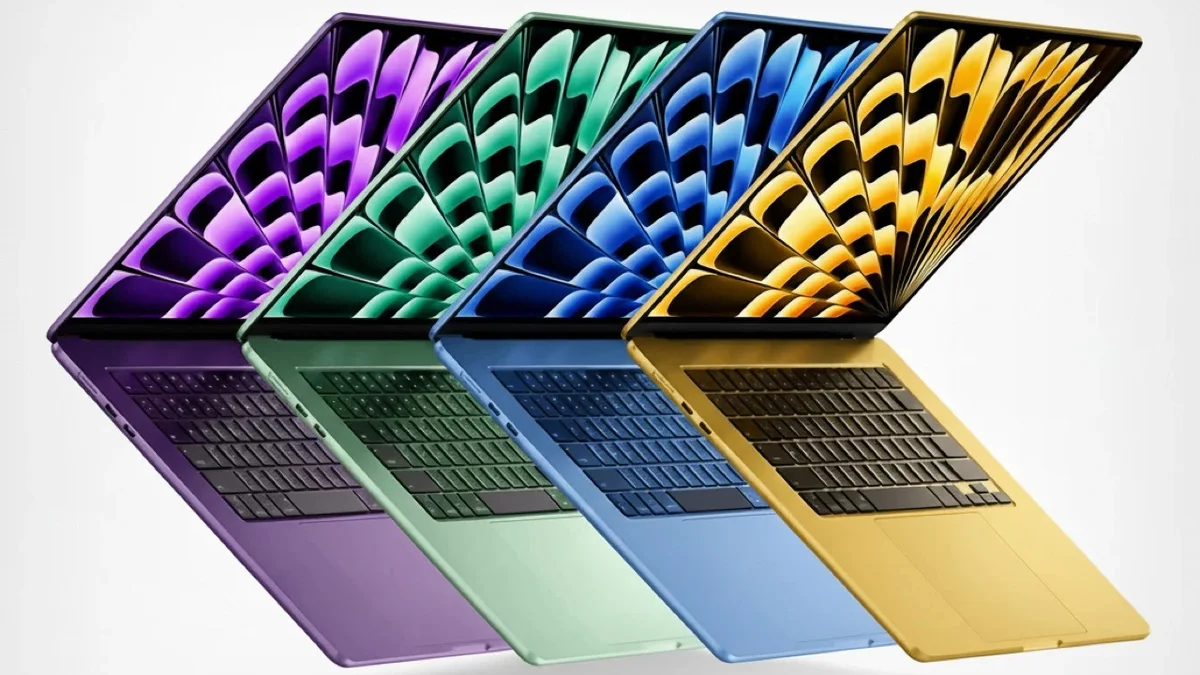
Apple is about to shake up its own premium strategy with the imminent arrival of a entry-level MacBook whose price could start below $600. The announcement is expected during a keynote scheduled for March 2026, according to Mark Gurman of Bloomberg. Even more surprisingly, this economical model would be available in a range of playful and unprecedented colors for a brand laptop, breaking with the traditional space gray and silver.
A conquest strategy against Chromebooks
This new MacBook, codenamed J700, clearly aims to fill a strategic gap. Until now, Apple had no competitive offering against Chromebooks and entry-level Windows PCs, segments where prices generally range between $300 and $700. By positioning this product well below $1,000 (some estimates even suggest $500 to $600), the Cupertino firm seeks to broaden its user base, particularly among students and occasional users.
The timing is all the more relevant as the education market represents a major challenge for computer hardware manufacturers. Until now, Apple has struggled to compete with the ultra-competitive offers of its rivals in this sector.
An A18 Pro chip to reduce costs
The major innovation of this MacBook lies in its architecture. Instead of using an Apple Silicon M-series chip (M1, M2, M3, M4), Apple would opt for the A18 Pro chip, the very one that currently equips the iPhone 16 Pro. This decision marks a bold technological break: recycling a processor designed for smartphones into a laptop.
Performance tests conducted by PCMag reveal that A-series chips (notably the A19 Pro) achieve single-core scores above 3,000 points, almost rivaling MacBook Air and Pro models equipped with the M4 chip. On the other hand, multi-core performance remains significantly lower, with scores peaking below 10,000 points compared to over 15,000 for M4 models.
However, this difference in raw power should not hinder the user experience for everyday tasks: web browsing, word processing, video streaming, and office applications would run smoothly. Even light gaming at low resolution would remain feasible according to analyses.
Aluminum and premium design despite the reduced price
Contrary to what an aggressive pricing might suggest, Apple would make no concessions on materials. The chassis would indeed be made of aluminum, and not plastic. The brand would have developed a new manufacturing process allowing these shells to be produced faster and at a lower cost, while maintaining the perceived quality by consumers.
The screen would measure approximately 12.9 to 13 inches, which is a slightly smaller diagonal than the 13.6 inches of the current MacBook Air. This size reduction would also contribute to lower production costs while maintaining a practical format for mobility.
Striking colors to attract a new audience
This is perhaps the most spectacular aspect of this launch: Apple would have tested a range of bright and cheerful colors, including light yellow, light green, blue, pink, classic silver, and dark gray. Not all of these shades will necessarily be marketed, but their mere presence in the testing phase signals a clear desire for visual differentiation.
This color strategy directly recalls that adopted for the 24-inch iMac M1 launched in 2021, which offered seven distinct colors. The objective is clear: to attract a younger or more creative audience, seeking aesthetic personalization that current MacBooks, limited to neutral tones, do not allow.
By integrating these playful colors, Apple is trying to replicate on the portable segment what worked on its all-in-one desktop computer. A strategy that could appeal far beyond the simple price argument, by offering a strong visual identity to a product designed for the general public.
A risky but calculated gamble
The launch of this entry-level MacBook is a large-scale test for Apple. The company is betting that the combination of an accessible price, colorful design, and the macOS ecosystem will be enough to convince a clientele usually drawn to less expensive alternatives. The performance of the A18 Pro chip, although limited in intensive multitasking, should satisfy daily uses without major frustration.
It remains to be seen whether consumers will accept the compromises inherent in this positioning, particularly in terms of computing power for demanding tasks. For professionals and creatives, MacBook Air and Pro models equipped with M chips will remain essential. But to capture market share in the student and family segment, Apple seems to have found a balanced formula between price, design, and sufficient performance.

No comments yet — start the discussion!