







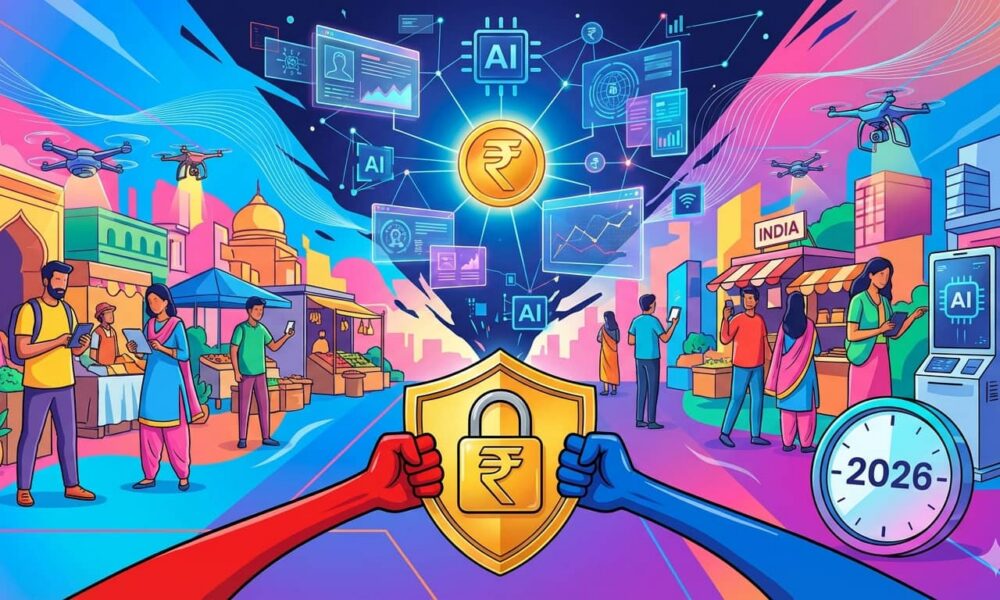
India became in 2025 the world's largest market of generative AI app downloads, with 207% growth in one year. But turning these hundreds of millions of users into paying subscribers remains the decisive challenge for OpenAI, Google, and Perplexity on the eve of 2026.
Unprecedented boom, fueled by free access
The figures are staggering. In 2025, India recorded peaks in generative AI app downloads, reaching 320% in September and 260% in October year-on-year, according to Sensor Tower data shared with TechCrunch. The country now represents about 19% of the global user base for major AI assistant applications, significantly ahead of the United States, which accounts for 10%.
This massive adoption owes much to a deliberate strategy by major players in the sector. Google partnered with Reliance Jio, the country's leading telecom operator, to integrate free or discounted AI tools into data plans. Perplexity collaborated with Airtel, the second-largest operator, to offer one year of Pro access to its subscribers, an offer valued at around 17,000 rupees. OpenAI, for its part, launched the ChatGPT Go plan for free across the country for one year.
India, a global AI laboratory
Beyond immediate commercial gain, AI companies see India as a unique experimentation ground. With over a billion internet users and around 700 million smartphone owners, the country offers a diverse, multilingual user base with a high volume of interactions. According to analysts cited by CNBC, tech giants are targeting India not only as a consumer market but also to train their models on complex digital behaviors, including mixed languages and voice usage that is underrepresented in Western data.
This strategic positioning materialized during the Summit on the Impact of AI organized in New Delhi in February 2026, which brought together Sam Altman (OpenAI), Dario Amodei (Anthropic), and Sundar Pichai (Alphabet/Google), according to the OECD. The simultaneous presence of the leaders of the three largest global AI firms in the Indian capital testifies to the country's growing weight in the global race for artificial intelligence. The Indian AI market is estimated at $21.65 billion in 2024 and could reach $257.45 billion by 2035, with an annual growth rate of 25.24%, according to Spherical Insights.
The paradox: 20% of downloads, 1% of revenue
The imbalance is striking. India generates about 20% of global generative AI app downloads but accounts for only about 1% of in-app purchases, according to Sensor Tower. This gap reveals the structural difficulty of monetizing a market where consumers are numerous but where spending power dedicated to digital subscriptions remains limited. ChatGPT alone accounts for over 60% of generative AI in-app revenue in the country, meaning its pricing decisions directly influence the entire market.
The effects of aggressive promotions immediately impacted revenue figures. In November and December 2025, in-app revenue for AI applications in India fell by 22% and 18% respectively month-on-month, according to Sensor Tower. ChatGPT's decline was even more severe, with a drop of 33% and then 32% over these two consecutive months, directly correlated with the launch of the free Go version in November 2025.
2026: the moment of truth for conversion
The turning point has begun. Perplexity ended its bundle offer with Airtel in January 2026, and free access to the ChatGPT Go plan in India is no longer available. These gradual withdrawals constitute the first real large-scale test user loyalty: how many of the hundreds of millions won over for free will agree to switch to a paid subscription? In January 2026, ChatGPT had 180 million monthly active users in India, followed by Google Gemini with 118 million, Perplexity with 19 million, and Meta AI with 12 million, according to Sensor Tower.
However, the engagement of Indian users remains lower than that of mature markets. In 2025, American users spent about 21% more time per week on major AI chatbot applications and had 17% more average sessions compared to their Indian counterparts. This engagement deficit complicates conversion to premium offers, whose perceived value depends largely on the intensity of use.
Towards adapted economic models
Companies will necessarily have to adapt their pricing approach to the local context. Sneha Pandey, an analyst at Sensor Tower, told TechCrunch: "AI in-app revenue will likely see significant but gradual improvement as users integrate more deeply into these platforms, making sustained engagement paramount." She added that price pressure is expected to remain high, making low-end subscription tiers, telecom offers and micro-transactions essential for long-term retention.
The example of Perplexity clearly illustrates the scale of the challenges. The platform plans a $400 million investment in India in 2026, and its partnership with Airtel generated a 640% increase in users, according to Incremys. As Tarun Pathak, an analyst at Counterpoint Research, quoted by the BBC, notes: "The strategy is to hook Indians on generative AI before moving them to a paid model."
India has all the ingredients to become one of the world's leading AI markets in absolute value by the end of the decade. The transition from a "growth at all costs" model to sustainable monetization will require innovative and localized pricing strategies. The coming quarters will indicate whether this exceptional leap in users can translate into concrete revenue, and which player, between ChatGPT, Gemini, and Perplexity, will succeed in establishing itself as the premium choice for a billion Indian internet users.



No comments yet — start the discussion!