







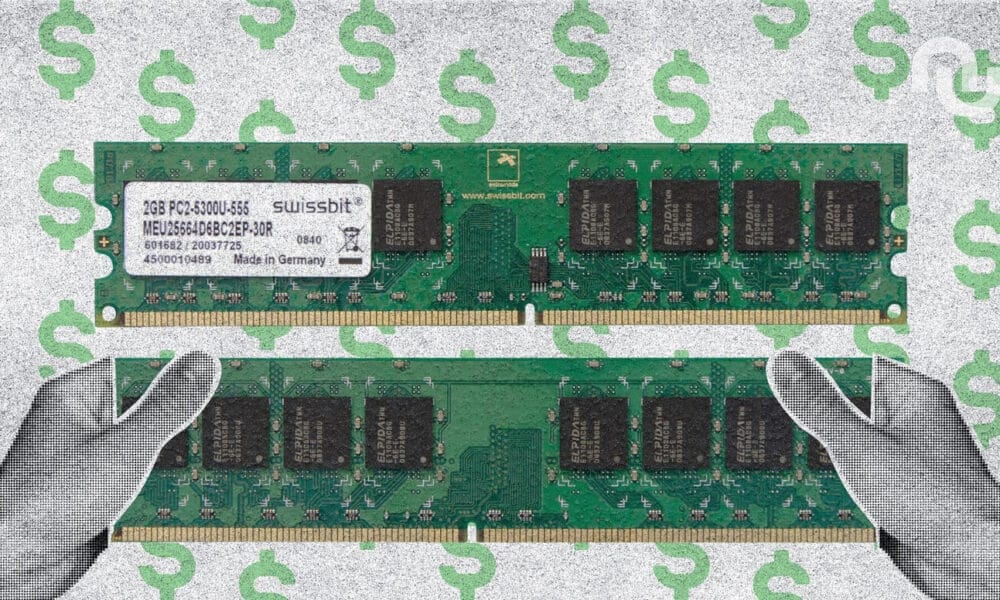
The warning came from an unexpected place: a Taiwanese television show. Pua Khein-Seng, CEO of Phison Electronics, one of the world's largest manufacturers of controllers for SSDs, made a prediction that has since swept the tech world. According to him, the RAM shortage intensifying in 2026 could force several consumer electronics manufacturers to abandon entire product lines, or even go bankrupt.
When AI empties memory warehouses
The root cause of this crisis is structural. The data centers dedicated to artificial intelligence are currently consuming unprecedented volumes of memory in the industry's history. Training and deploying large AI models requires massive amounts of standard DRAM, but especially HBM (High Bandwidth Memory), this vertically stacked memory that equips Nvidia GPUs and modern AI accelerators.
The problem is that producing HBM uses more wafer surface area per unit than traditional DRAM. With constant industrial capacity, every wafer dedicated to HBM is a wafer that does not produce DDR5 or DDR4 for PCs, laptops, or smartphones. Result: RAM prices have tripled, quadrupled, or even sextupled in a few months, and SSD prices have jumped by 90% in a single quarter.
What Phison's CEO really said
During his appearance on the Next TV channel on February 13, 2026, Pua Khein-Seng answered direct questions about the future of the industry. He confirmed that companies unable to secure their memory supplies in the second half of 2026 would be forced to reduce their product catalogs, and that some might not survive. He also presented a broader perspective: in the coming years, consumers might be led to repair their devices rather than buying new ones, due to insufficient supply at accessible prices.
These statements do not come from a financial analyst theorizing from an office. Phison itself had to negotiate directly with DRAM manufacturers to obtain memory for its own Gen5/Gen6 test servers. The CEO is talking about a reality he experiences daily in his own supply chains.
A shortage until 2030, or even beyond
What makes the situation particularly concerning is the estimated duration of the crisis. According to information reported by PC Gamer, memory manufacturers estimate internally that the shortage will persist until 2030, and some are even projecting a decade of tension. These same manufacturers are now reportedly demanding up to three years of prepayment, an unprecedented practice in the electronics industry.
New semiconductor manufacturing plants are under construction, but they won't be operational until 2027 or 2028 at the earliest. In the meantime, the market is operating under extreme pressure, with only three companies – Samsung, SK Hynix, and Micron – controlling 93% of global DRAM production. These players prioritize profitability and are deliberately avoiding overproduction, which has caused massive losses in the past.
Nvidia, Apple, PS6: giants are also affected
The consequences extend far beyond the industrial components market. Nvidia is reportedly considering not launching gaming GPUs this year, which would be a first in the brand's thirty-year history in this segment. Apple is facing difficulties in obtaining sufficient memory, both for its chips and for its devices' SSDs. The release of Sony's PS6 is also said to be affected by these supply constraints.
On the PC side, the situation is just as tense. Lenovo, Dell, HP, Asus, and Acer are all reportedly considering price increases of 10% to 20% on their laptop ranges. Yang Yuanqing, CEO of Lenovo, told Bloomberg that his memory costs had increased by 40% to 50% in the last quarter, and that these costs could double soon. Nirav Patel, CEO of Framework, a manufacturer of modular and repairable laptops, summarized the situation in one sentence: "We price just to cover what we pay our suppliers."
The DDR4 to DDR5 transition makes everything worse
An often underestimated aggravating factor is the ongoing technological transition between DDR4 and DDR5. Manufacturers are actively reducing their DDR4 production to reposition themselves on DDR5, which is more profitable and better aligned with the needs of AI infrastructure. However, many existing industrial projects and consumer devices still rely on DDR4, with supply lead times now reaching several tens of weeks in some cases.
DDR5 itself is more complex to produce than its predecessor, as it integrates its own power management circuits directly onto the module, adding manufacturing steps to an already strained chain. We thus find ourselves in a situation where the latest consumer memory is more expensive to produce, cannibalized by ultra-priority HBM, in a context of global demand recovery post-Covid.
What this means for the consumer
The concrete impact for the end-user will be gradual but real. Smartphone and laptop prices are expected to increase throughout 2026, while some models may simply disappear from catalogs. Companies that do not have the negotiating power of Lenovo or Apple to secure volumes in advance will be the first victims. Mid-sized brands, those that cannot afford three years of prepayment, are on the front line.
The crisis of HBM and DRAM memory 2026 is not just an industry cycle. It is a structural break linked to the irresistible rise of AI, which is reshaping the priorities of an entire industrial sector to the detriment of the mass market.




No comments yet — start the discussion!