







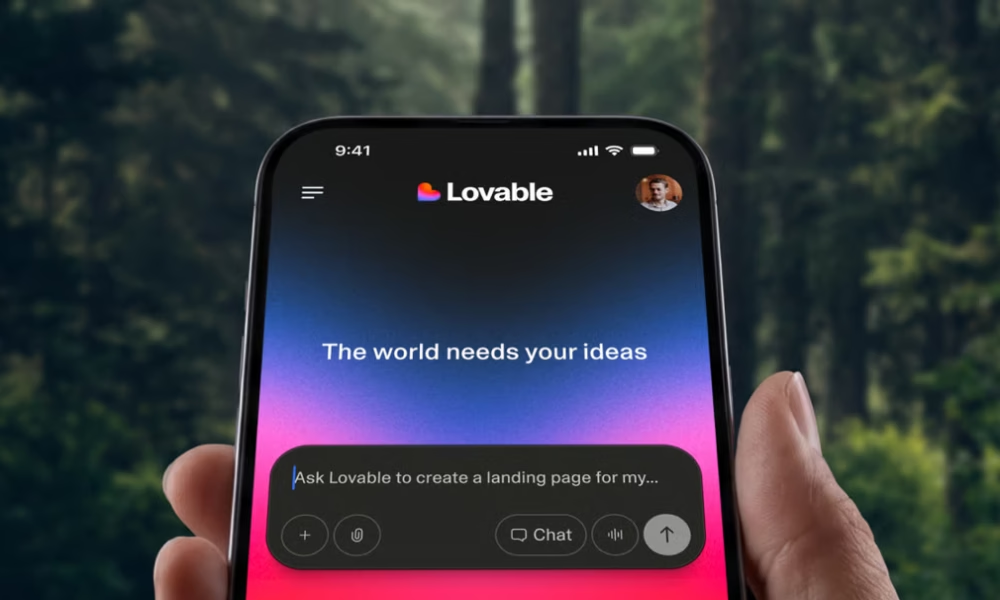
Lovable launches its vibe coding app on iOS and Android on April 28, 2026. Coding from your smartphone becomes possible thanks to voice and text prompts, even without development experience.
Present on mobile where its competitors have stumbled
The context in which Lovable arrives on mobile is particularly tense. In March 2026, Apple blocked updates for several popular vibe coding tools, notably Replit and Vibecode, invoking App Store directive 2.5.2, which prohibits apps from downloading or executing code capable of modifying their own functionalities, according to MacRumors. The Anything app was also temporarily removed from the App Store for the same reasons, before returning after making the necessary adjustments.
In this context, the launch of Lovable on mobile is a strong signal. The Swedish startup has clearly taken care to design its application in compliance with Apple's rules from the outset, where its competitors had to adapt their existing products under duress. The distinction is important: Lovable does not claim to generate native applications installable directly from its mobile tool, but rather websites and web applications functional web applications, which elegantly bypass Apple's main restriction.
What the application concretely allows
The central idea of Lovable's mobile application is simple: to allow coding at any time, from anywhere, by submitting instructions via text or voice. A user can start a project from their phone, let Lovable's agent work autonomously, and then receive a notification when the version is ready to be reviewed.
The application also integrates continuity between devices. It is possible to start a project on a computer, resume it on a smartphone, and vice versa, without interruption in the workflow. This functionality particularly targets entrepreneurs and teams who switch between different environments throughout their day. By redirecting previews of generated applications to a web browser rather than displaying them within the host application, Lovable complies with the condition that Apple now imposes on all tools for AI application building present on the App Store.
Directive 2.5.2: a turning point for the entire sector
Apple's intervention in spring 2026 redefined the boundaries of what vibe coding tools can do on iOS. Directive 2.5.2 has existed for several years, but its application to generative AI tools has created a clear break: applications can no longer display dynamically generated code within themselves, as this prevents Apple's review team from properly controlling the submitted content and represents a security risk for end-users, Apple specified according to MacRumors.
In concrete terms, vibe coding tools like Replit or Vibecode previously displayed their generated applications in an integrated web view. Apple now requires these previews to open in an external browser. This seemingly minor change challenges the user experience model that these platforms had built, and explains why several of them had to suspend their updates while they complied.
A European unicorn at the peak of its trajectory
Lovable is not an ordinary startup in this sector. Founded in 2024 and based in Stockholm, the company reached $100 million in annual recurring revenue (ARR) in just eight months of existence, then doubled this figure to exceed $200 million in ARR four months later, according to TechCrunch. In December 2025, the startup announced a $330 million Series B funding round, led by CapitalG (Alphabet's growth fund) and Menlo Ventures, bringing its valuation to $6.6 billion. Khosla Ventures, Salesforce Ventures, and Databricks Ventures also participated in this round.
This Series B followed a $200 million Series A completed in July 2025, which already valued Lovable at $1.8 billion, according to Reuters. In the space of five months, the startup's valuation has therefore more than tripled. The company claims over 100,000 new projects created daily on its platform and over 25 million projects in total during its first year of existence, with clients such as Klarna, Uber, and Zendesk.
The arrival of the mobile application is part of this accelerated expansion strategy. Lovable indicated its intention to use the funds raised to strengthen third-party integrations, develop business-oriented features, and build the necessary infrastructure (databases, payments, hosting) for complete applications.
The launch on iOS and Android marks a key step in the democratization of no-code development. By making web application creation accessible from a smartphone, Lovable opens its tool to a much wider audience, especially those who do not always have access to a computer. The next question is whether this mobile approach will become the norm in the vibe coding sector, or if other competitors will manage to offer an equivalent experience without encountering the constraints imposed by Apple and Google.



No comments yet — start the discussion!