



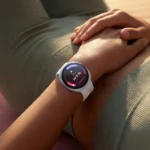



Fitbit Gemini is now available in France and 36 other countries, transforming Google's health tracking app into a true artificial intelligence-powered personal coach. After more than six months of waiting, European users can finally discover this major overhaul.
A redesign announced since Fall 2025
The story of this update begins in the summer of 2025. During the presentation of the watches Pixel Watch 4 in August 2025, Google unveiled its vision for a new AI-driven Fitbit app. The complete overhaul of the experience, renamed Fitbit Personal Health Coach, was put into Public Preview in the United States as early as October 2025, initially reserved for Fitbit Premium subscribers on Android.
In February 2026, Google expanded this rollout to Canada, the United Kingdom, Australia, New Zealand, and Singapore, also opening access to iOS users, according to Google's official blog post. But European markets, including France, still had to wait.
Deployment in 37 new countries
On April 9, 2026, in an official blog post, Google announced the deployment of the new Fitbit app in 37 new countries, including France, Belgium, and Switzerland. The update is being rolled out gradually via the Fitbit app version 4.67. For affected users, an update notification appears directly in the app.
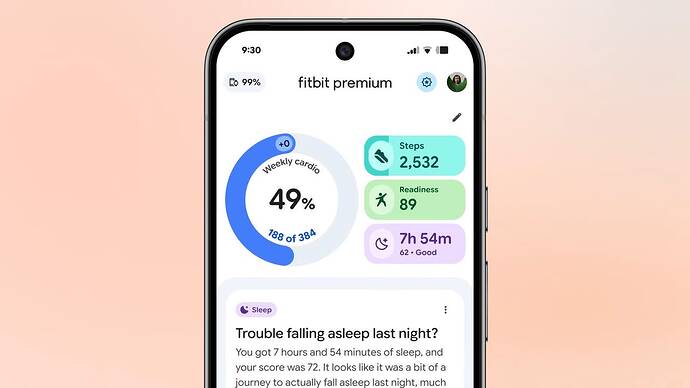
The interface has been completely redesigned according to the principles of Material Design 3, with better highlighting of key scores such as sleep, cardio load, and daily readiness. The app now supports 27 languages, including French, a clear sign that Google is aiming for broad international adoption for this product.
What Gemini changes concretely
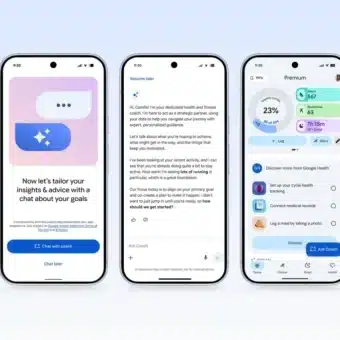
The contribution of Gemini goes far beyond a simple visual refresh. Unlike the old Fitbit Coach, which offered static and pre-established training programs, the new version relies on Gemini's language models to offer a conversational experience. A "Ask the coach" button allows you to directly query the AI, which can analyze your data to answer specific questions: why was your sleep score low last night, how to interpret your stress level, or how to adjust your physical activity.
The coach can cross-reference multiple data sources simultaneously, such as a late sports session, a meal entered in the nutrition log, and your nighttime heart rate, to put the displayed metrics into perspective. The application now integrates a AI analysis of VO2 Max, a cardio-respiratory capacity indicator previously displayed as a simple numerical value, which now becomes the result of more in-depth contextual analysis.
Stated medical ambitions
Google doesn't stop there. During its annual event The Check Up, on March 17, 2026, Google unveiled three substantial updates for the Personal Health Coach, including the integration of clinical data clinical data into the coach's recommendations. The idea is to transform Fitbit into an advisor capable of contextualizing its advice based on data from medical records, and no longer just from wrist-worn sensors.
This direction illustrates Google's overall strategy: to reposition Fitbit not as a simple step counter, but as a AI-centric health platform, facing competitors like Apple Health and Samsung Health, which offer advanced analysis functions at no additional cost.
The price of artificial intelligence
One point deserves attention: the coach powered by Gemini is exclusively reserved for subscribers Fitbit Premium, Google's paid offering. The price is set at 8.99 euros per month or 79.99 euros per year. This choice contrasts with the approach of Apple and Samsung, who have progressively integrated their advanced analysis functions at no extra cost for owners of their smartwatches.
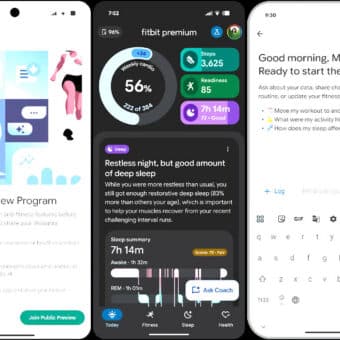
Furthermore, it is currently Public Preview, that is to say a public beta version that may still present bugs or incomplete features. To join the program, simply open the Fitbit app, tap on your profile in the top right corner, then select "Public Preview" and "Join Public Preview".
Compatibility to know
Access to the new application is conditional on using a Pixel Watch or a compatible Fitbit band. Users of other brands' devices, even with a Fitbit Premium subscription, will not be able to benefit from this update. This hardware exclusivity is a potential barrier to mass adoption, in a European market where Fitbit remains a recognized brand but faces intense competition.
For owners of a Pixel Watch 2, 3, or 4, or a recent Fitbit band, the invitation to join the preview represents a concrete opportunity to test what Google envisions for the future of connected health. If the ambitions match the announcements, Fitbit could regain a central place in a sector it dominated for a long time before the rise of consumer smartwatches.


No comments yet — start the discussion!