







Apple Music could soon offer a free offer, one month after one of its executives declared himself "proud" not to have one. Lines of code discovered in the Android beta reveal the first clues.
When code contradicts official statements
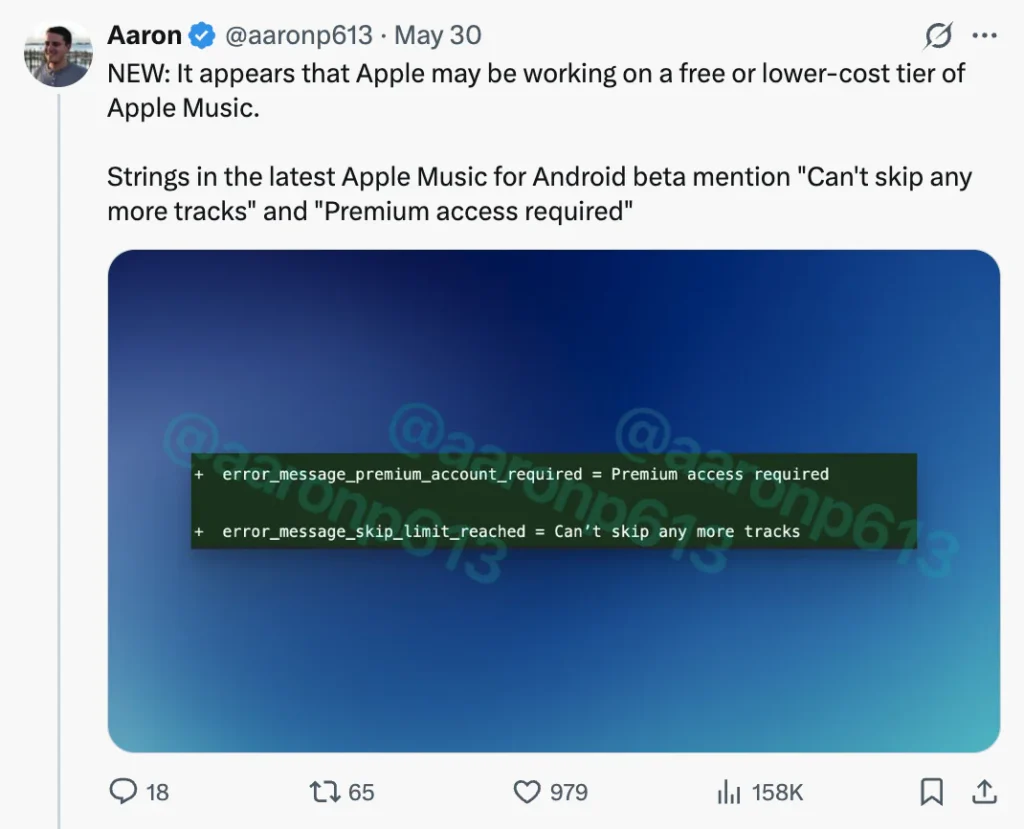
On May 30, 2026, Aaron Perris, a developer and contributor at MacRumors, published a discovery on X that immediately caught the industry's attention. In the latest beta version ofApple Music for Android, two unusual text strings have appeared: "Can’t skip any more tracks" and "Premium access required". These messages have no use in the current architecture of the service, which knows neither skip limits nor access level distinctions.
The peculiarity of this discovery lies in its context. A month earlier, in April 2026, Oliver Schusser, vice president of Apple Music and international content, had expressed himself unambiguously in an interview with Bloomberg. "I think 'free' was a terrible idea. Apple Music is the only service that doesn't have a free tier, and believe it or not, we are really proud of that," said Oliver Schusser, vice president of Apple Music and international content. ( "I think 'free' was a terrible idea. Apple Music is the only service that doesn’t have a free tier, and believe it or not, we are really proud of that.") This firm and repeated stance (Schusser had already made similar statements in the past) makes the appearance of these strings in the code a few weeks later all the more surprising.
What the code strings actually reveal
The two messages identified by Perris point to an access tier system that does not yet exist in Apple Music. The first message suggests that a user would reach a track skipping quota, a feature absent from the current subscription. The second indicates that an action would require "premium" level access, implying the existence of a lower tier without this access. Perris himself points out that these elements could concern something else, such as radio stations, without necessarily meaning a free tier literally.
Several interpretations therefore remain open. Apple could be testing a free, ad-supported offer, similar to Spotify's. The company could also be considering a cheaper paid tier, with restrictions, like YouTube Music Premium offers at different prices depending on the market. None of these hypotheses have been confirmed, and Apple has made no official statement on the matter. The fact that these strings were found in the Android beta (and not iOS) is also worth noting: it suggests that such an offer would not be limited to iPhone or iPad users only.
Commercial pressure increasingly difficult to ignore
While Apple has long maintained its premium position, market data is beginning to weigh on this strategy. According to the "Music subscriber market shares Q4 2024" report by MIDiA Research, Apple Music and Amazon Music together added only 6 million subscribers over the entire year 2024, while Spotify gained 28 million in the same period. Apple Music holds third place globally with an estimated market share of 11.6%, compared to 32.2% for Spotify, whose number of paying subscribers reached 236 million at the end of 2024 according to its own financial results.
MIDiA Research explicitly attributes this growth gap to Apple's lack of a free tier, which deprives the service of a massive acquisition funnel. Spotify, in fact, draws a significant portion of its new paying subscribers from its free user base. Markets outside North America and Europe, which currently represent 78% of new global subscribers according to the same organization, are precisely the areas where the presence of free access is most crucial for gaining visibility. Apple, still largely perceived as a closed ecosystem brand in these regions, suffers from a structural lack of exposure compared to its competitors.
WWDC 2026, a possible but uncertain stage
Apple's annual developer conference, WWDC 2026, is scheduled for June 8, 2026, less than a week away. Several observers believe this deadline could serve as a platform for an announcement regarding the evolution of Apple Music subscriptions. The presence of these channels in a recent beta version suggests that development is underway, even though nothing guarantees an imminent announcement. Apple could just as easily present this evolution at a later event, or decide not to proceed at all if internal tests are not conclusive.
It should also be recalled that Apple already offers a form of service bundling through Apple One. This package includes Apple Music, Apple TV+, Apple Arcade, iCloud+, Apple Fitness+, and Apple News+ starting at $19.95 per month for an individual subscription, or $25.95 per month for a family of up to five people. This bundle approach distinguishes Apple from its competitors, but does not address the demand for free access for users who do not wish to commit to a subscription.
The question raised by Aaron Perris's code strings is therefore less about 'if' and more about 'how'. If Apple decides to take the plunge, the precise form of this offer, with or without ads, with what restrictions, at what potential price, will determine whether the service finally manages to capture a new generation of listeners that Spotify and YouTube Music currently share without serious competition. WWDC 2026 could provide a first answer.

No comments yet — start the discussion!