







The ChatGPT memory goes to a new level. OpenAI announced on June 4, 2026, the deployment of a completely redesigned architecture to make the assistant more accurate and useful in the long term.
For two years, ChatGPT's memory function has progressed in stages. But each generation hit the same limits: memories that aged poorly, preferences forgotten between conversations, and an inability to account for the passage of time. With Dreaming V3, OpenAI claims to have built a radically different foundation, capable of handling the hundreds of millions of users on the platform over horizons of several years.
How ChatGPT's memory has evolved since April 2024
The first memory system, launched in April 2024 under the name "saved memories," relied entirely on user initiative. You had to explicitly ask ChatGPT to retain information for it to be saved. OpenAI itself acknowledges that this approach was akin to talking to someone who took a few notes but forgot everything that wasn't written down: "In practice, interacting with this system could feel like talking to someone who took a few notes, but still forgot everything that wasn’t written down." In practice, saved memories also tended to become inaccurate over time.
In April 2025, a first version of the "Dreaming" mechanism was introduced. This background process allowed ChatGPT to automatically analyze conversation history to synthesize memories without explicit user instruction. A real breakthrough, but insufficient according to OpenAI to function as an autonomous system. Dreaming V0 then complemented saved memories, without replacing them.
On June 4, 2026, OpenAI announced Dreaming V3, a third generation that now forms the sole backbone of ChatGPT's memory system. Manually saved memories do not disappear, but it is Dreaming that structures and maintains the entire context retained for each user.
Three criteria for evaluating good memory
To design this new architecture, OpenAI defined three specific objectives. The first is context continuity : the user should not have to reintroduce themselves at the beginning of each new conversation. If ChatGPT has already discussed camera equipment with the user, it should be able to make compatible recommendations without being reminded of the equipment concerned.
The second objective is to respect preferences and constraints. If the user has mentioned that they are vegetarian, ChatGPT must incorporate this constraint into all future culinary suggestions, coherently and without exception. This type of preference can be explicit (a direct instruction), implicit (contextual information such as place of residence), or behavioral (a habit deduced from several exchanges).
The third criterion is the automatic updating of memories over time. This is where Dreaming V3 makes the most concrete difference compared to previous generations.
Memories that correct themselves over time
Traditional memory systems kept fixed information, without a mechanism to question it. An example given by OpenAI precisely illustrates this problem: the user informs ChatGPT of a trip to Singapore planned for July. Normally, ChatGPT would retain this context indefinitely, still suggesting local restaurants or activities long after the user's return.
With the new architecture, the AI memory update is done automatically over time. OpenAI explains that the assistant is now capable of reformulating its memory itself once the trip is over: "You’re going to Singapore in July" becomes "You went to Singapore in July 2026", allowing ChatGPT to once again offer recommendations adapted to the user's home, their time zone, and their current plans. (With dreaming, memories are automatically updated as time passes, allowing ChatGPT to revise its memory from “You’re going to Singapore in July” to “You went to Singapore in July 2026” when the trip ends.)
This mechanism applies to any temporally dated context: ongoing projects, upcoming events, evolving professional or personal situations. The goal is for ChatGPT to adapt its responses not only to who you are, but also to where you are at the time of the conversation.
A summary page to view and correct what ChatGPT retains
Another concrete innovation of this update is a memory summary page, directly accessible within the ChatGPT interface. This page presents in a readable format the information the assistant has retained about the user, organized by theme. From this screen, it is possible to correct erroneous information, add new information, or tell ChatGPT which topics it should address or, conversely, avoid. OpenAI specifies that to delve deeper into a particular point, the user can simply start a conversation with the model directly from this page.
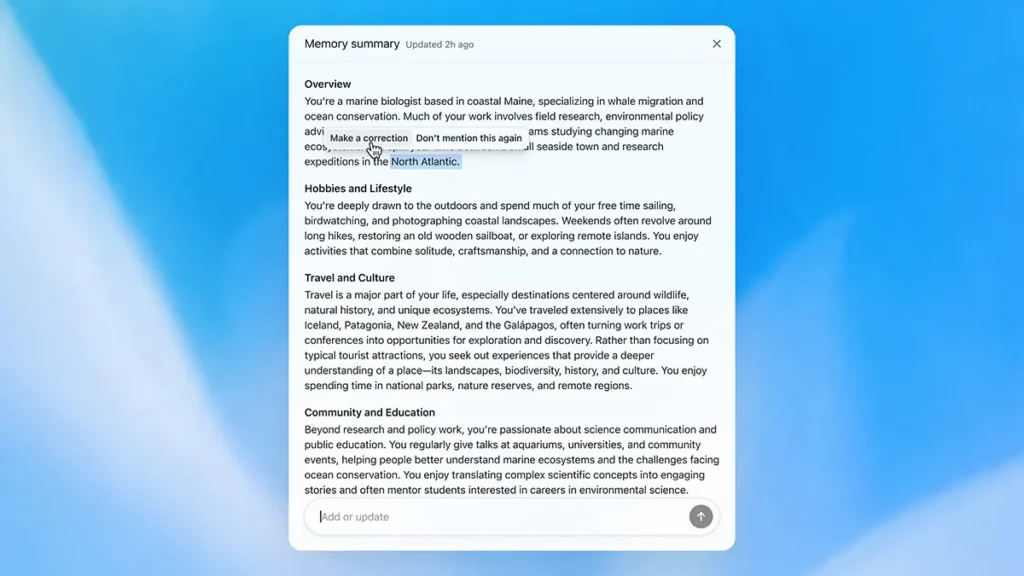
This transparency represents a notable change in the relationship between the user and the assistant. Until now, it was difficult to know precisely what ChatGPT had retained or not. The summary page makes this context auditable and modifiable, which strengthens trust in the long-term use of the feature.
A five-fold calculation gain that opens access to free users
Perhaps the most significant aspect of this update is not visible in the interface: it is a considerable gain in technical efficiency. OpenAI indicates that the new architecture reduces the computing resources required to run Dreaming by approximately five times compared to the previous version. This progress is directly responsible for the extension of the functionality to free ChatGPT users, previously excluded for reasons of operational cost.
The rollout is happening in two phases. Since June 4, 2026, the new Dreaming V3 memory has been available to Plus and Pro subscribers in the United States. In the following weeks, OpenAI plans to extend the rollout to other countries and make the functionality accessible to Free and Go plans. The efficiency gain will also allow for an increase in the memory capacity available to Plus and Pro users, at no additional cost to these subscribers.
For users who rely on ChatGPT for long-term or recurring projects, this update concretely changes how the assistant understands and anticipates their needs. For those who have not yet explored the application's memory settings, now is the right time to do so: the summary page is now the most direct entry point to control what ChatGPT knows about you.

No Comment! Be the first one.