





The Google video selfie becomes a new recovery method to retrieve a locked account. The feature relies on facial recognition with several safeguards.
Google officially announced this option on July 23, 2026. It is intended to help users who have lost their phone, can no longer use their usual device, or no longer have access to their other login methods.
How Does Google Video Selfie Work?
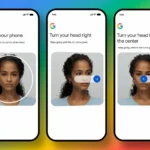
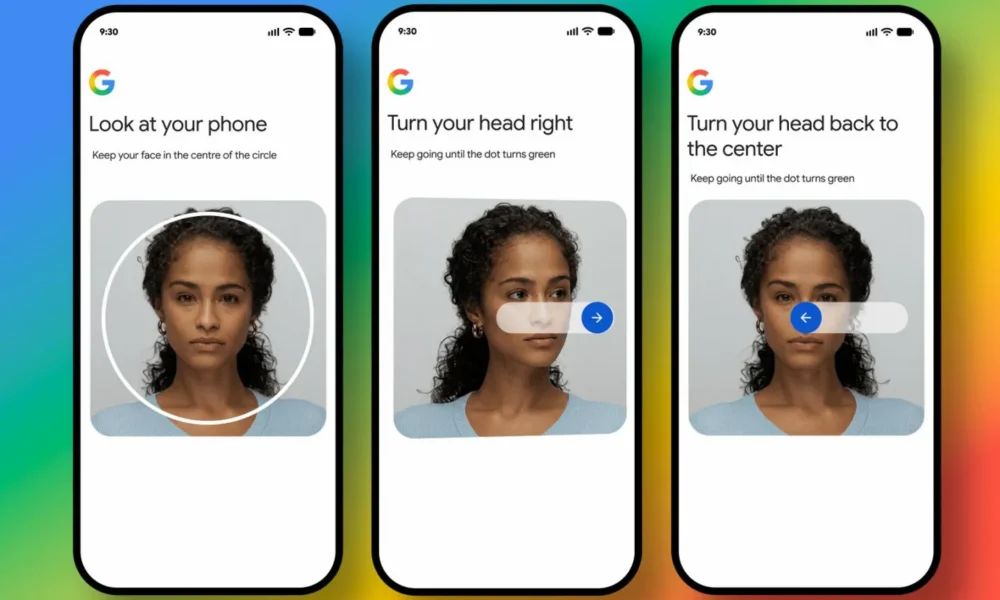
The principle involves two successive recordings. During setup, the user looks at the camera of their smartphone or computer and follows several on-screen instructions. Google asks them to make slight head movements to capture their face from multiple angles.
This first video becomes a reference associated with the account. If the owner later encounters difficulties logging in, they can record a new video selfie. Google then compares the two sequences to determine if the person filmed matches the one who activated the feature.
Therefore, simply presenting a photo to the camera is not enough. The requested movements serve to verify that the image comes from a person actually present at the time of the login attempt. However, Google does not publicly detail all the technical criteria used by its system.
The feature must be set up before losing account access. A user who is already locked out will not be able to retroactively create a reference video, as Google would have no reliable element with which to compare their face.
Google Video Selfie Does Not Replace Your Password
Despite its name, this new feature is not intended to become the primary daily login method. Google presents it as a supplementary recovery solution, intended for situations where usual methods are no longer available.
Passwords, passkeys, recognized devices, phone numbers, and recovery contacts remain relevant. The company also recommends setting up multiple different methods to avoid relying on a single phone or email address.
The comparison with Apple's Face ID should also be nuanced. Face ID relies on infrared sensors integrated into certain devices and works locally to unlock them. Google's video selfie uses a standard camera and is used to regain access to an online account from different devices.
A passkey also remains technically very different. It relies on a pair of cryptographic keys and allows login without transmitting a reusable secret. The video selfie, on the other hand, relies on comparing two representations of the face. It primarily addresses the problem that arises when the device containing the passkey is no longer accessible.
Liveness Detection Against Photos and Deepfakes
With the advancement of tools capable of generating or modifying faces, facial recognition can no longer rely solely on visual resemblance. A stolen photo from a social network or a pre-recorded video could otherwise be enough to fool a too-simple system.
Google claims to use multiple security layers to limit impersonation attempts via photos, fake videos, or deepfakes. The comparison with the initial recording is supplemented by guided movements, which serve as a liveness test. Standard mechanisms for detecting suspicious connections also continue to apply.
However, this protection is not an absolute guarantee. Google does not publish any rates for false positives, false rejections, or resistance to the most advanced deepfakes. The video selfie should therefore be considered an additional recovery factor, not infallible proof of identity.
The stakes are particularly high, as an insufficiently protected recovery procedure can become the weak point of an otherwise secure account. The hacking of Instagram accounts via Meta AI had precisely shown how a support mechanism could be circumvented when identity checks were insufficient.
What Happens to the Video Recorded by Google?
The main trade-off concerns privacy. To use this feature, the user agrees to Google storing a video of their face on its servers. Unlike some biometric methods limited to a device, the reference must remain accessible from the account to be used during a future recovery.
Google states that the video is encrypted when stored. By default, it is only used to facilitate account login. However, a separate option can allow the user to authorize other uses. This additional authorization is not presented as mandatory to benefit from selfie recovery.
The recording can be deleted at any time from the Google account settings. Its deletion logically disables this backup method, as no reference remains available to verify a future selfie.
This deletion option gives the user some control, but it does not eliminate the fundamental choice. Activating the feature means entrusting sensitive facial data to Google in exchange for a potentially more convenient recovery method.
How to Activate Video Selfie on a Google Account?
Google offers a Page dedicated to video selfie setup. Once logged in, the user can check if their account is eligible and start recording by following the on-screen instructions.
The rollout is gradual worldwide. The absence of the option therefore does not necessarily mean that the device is incompatible or that the account has a problem. Google is currently only talking about eligible accounts, without publishing a detailed schedule for each country.
Recording can be done with the camera of a compatible smartphone or computer. It is preferable to be in a well-lit room, keep your face fully visible, and precisely follow the requested movements.
Google does not charge for this feature. It complements the recovery contacts and passkeys already offered in the security settings.
Google Video Selfie Primarily Improves Account Recovery
The novelty addresses a persistent weakness in digital security. Login systems are becoming more robust, but recovering an account after losing or having all devices stolen remains complicated. A highly secure passkey is of little use if it is only on an inaccessible phone.
The video selfie can then act as a backup key stored remotely. Its usefulness will be particularly evident for people who use Gmail, Google Photos, Drive, or 'Sign in with Google' as an entry point to a large part of their digital life.
However, this feature does not eliminate the need to enable two-factor authentication, save multiple passkeys, and keep backup codes in a secure location. The best system is one that combines different independent methods, so that the loss of a device or the compromise of information is not enough to permanently lock the account.
The Google video selfie thus offers a useful option for account recovery, but activating it involves accepting the storage of facial data by Google. Each user will have to weigh this additional protection against their personal privacy requirements.



No comments yet! Be the first.