




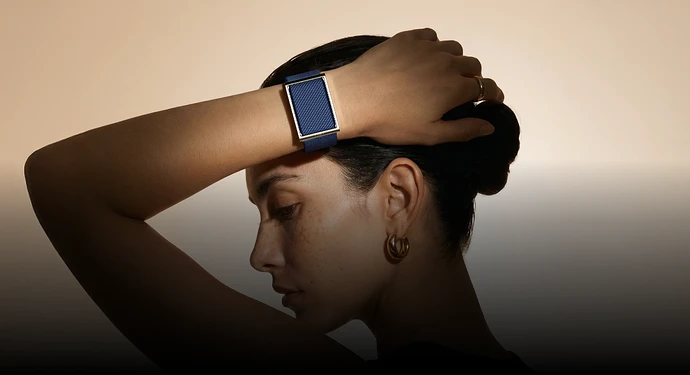
The health wearables market hasn't seen such a stir in years. And paradoxically, it's not Apple, Garmin, or Samsung that shook the industry at CES 2026 in Las Vegas. It's an Indian brand, Luna, owned by the Noise group (legally known as Nexxbase Technologies), which presented the Luna Band last January 5th. A screenless, subscription-free band, equipped with a feature no one had integrated at this level before: health guidance by voice. Enough for the giant Whoop to call its lawyers less than three weeks after the announcement.
A market ripe for disruption
For several years, the advanced health tracker segment has been dominated by a handful of players. Whoop reigns in the niche of screenless, performance-oriented bands, but its business model relies on a mandatory subscription, billed between $199 and $359 per year depending on the chosen tier, with the band included. This is both its commercial strength and its Achilles' heel: an increasing portion of the public refuses to pay perpetual rent to access their own body's data.
Luna, already known for its connected ring launched in 2023, saw an opening. Its positioning is simple: everything Whoop does, but purchased once for $149, with no recurring fees. A positioning gap that, on paper, immediately gives a considerable commercial advantage.
Voice over screen: a radical bet
What truly sets the Luna Band apart from its competitors isn't just the absence of a subscription. It's the interaction philosophy that has been completely rethought. Where most wearables accumulate data on a screen or in an app, the Luna Band is designed to talk to you and listen to you.
The device relies on LifeOS, the artificial intelligence system developed in-house by Luna. This engine analyzes biological signals in real-time and delivers advice directly via voice, through deep integration with Siri and any pair of headphones. Need to log a meal, describe a symptom, or ask if your recovery level allows for an intense workout? Just speak, without opening any app.
This approach is part of an acknowledged critique of the industry. At the launch, a Luna spokesperson was clear: "In a market saturated with devices that merely provide numbers and perform analyses, the Luna Band introduces a radically different philosophy: prioritize advice over data ". Guidance takes precedence over raw data.
What the sensors hide
Behind the minimalist casing available in four colors (intense red, orange, purple, and green) lies a solid hardware platform. Luna has integrated a "research-grade" optical sensor for heart monitoring and biomarkers, coupled with a six-axis motion sensor combining a high-fidelity accelerometer and gyroscope.
The stated ambition: to detect what classic bands miss. Micro-recovery periods, circadian fluctuations, emotional stress signatures, sleep alignment... LifeOS claims to identify these subtle variations to refine its real-time recommendations, without waiting for the next morning's report. The brand also covers a segment women's health, with integrated menstrual cycle tracking, alongside heart rate, blood oxygen level, skin temperature, and step count.
The Luna Band connects to Apple Health, Google Fit, Clue, and Kindbody, allowing it to aggregate fertility, nutrition, or sports coaching data from third-party platforms into a unified dashboard. It also works in tandem with the Luna Ring, the brand's connected ring, with both devices serving as primary sensors for LifeOS.
$149 without subscription: kicking the hornet's nest
The pricing strategy is the Luna Band's most immediately impactful argument. At $149 a one-time purchase, it falls well below the annual cost of a Whoop subscription. For comparison, the Amazfit Helio Band, a direct competitor with a similar form factor, is priced at $99 without a subscription, but lacks LifeOS's voice functionalities.
Luna is therefore positioning itself in a specific niche: users who want serious health tracking without compromising on sensor quality or the total cost of ownership. The brand's stated goal is to "democratize high-end health intelligence worldwide." This is an ambitious statement that will be tested by user feedback once the device is available for purchase.
Whoop calls in the lawyers
The best proof that Luna has hit the mark? Whoop's reaction. Just January 22, 2026less than three weeks after its CES unveiling, Whoop filed a lawsuit against Nexxbase Technologies for trademark and trade dress infringementinfringing on its product's visual identity. The American company believes that the Luna Band's design, a screenless band with a textile strap and metallic module, too closely imitates its own.
This isn't the first time Whoop has resorted to legal action to defend its territory; the brand previously sued Polar in a similar dispute. But this new procedure highlights a simple truth: when a competitor offers a visually similar product at a fraction of the total cost, the response is no longer marketing, it becomes legal. Luna has not yet publicly commented on the lawsuit.
What's still missing
For now, the Luna Band remains a CES product. Neither a release date nor precise availability has been announced As of today, the brand simply indicates a launch "during 2026." Journalists present in Las Vegas were able to handle a prototype, and initial impressions are generally positive regarding its construction and value proposition. However, LifeOS's promises will need to be validated under real-world conditions over time before a definitive judgment can be made against competitors like Whoop or Amazfit.
Android support also remains a gray area, as Luna has only confirmed Siri integration on iOS so far. For a brand aiming to democratize connected health globally, this will be one of the first issues to clarify before launch.

No comments! Be the first one.