Google has just released a detailed roadmap for its Google Health app, listing dozens of fixes and improvements planned starting this week and throughout the summer of 2026.
An official launch followed by rare transparency
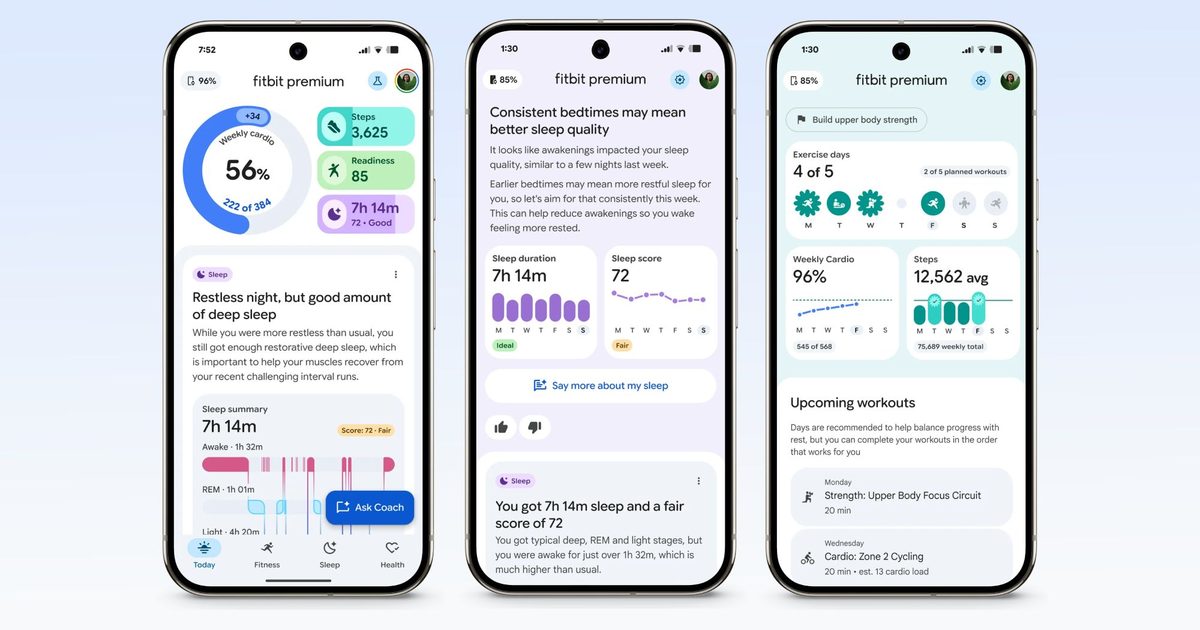
On May 19, 2026, the Fitbit app officially gave way to the new Google Health app, rolled out on Android and iOS for all users. This transition marks a complete overhaul of the experience, with a new interface organized into four tabs (Today, Fitness, Sleep, and Health), as well as the renaming of Fitbit Premium to Google Health Premium. Google Health Coach, powered by Gemini, is now accessible to Premium subscribers outside the public preview phase, and Google Fitbit Air is available for purchase.
Following this massive rollout, Google published on May 27, 2026, on its official community forum a complete list of planned fixes and evolutions, stating its desire to « maintain the spirit of public preview. » This approach is unusual for a large tech company: publicly acknowledging known bugs and committing to a precise delivery schedule.
Sports tracking at the top of priorities
An initial fix concerning sports activity tracking is already being deployed this very week. Google is fixing a bug that labeled some runs as generic workouts, and simultaneously adding run splits to activity summaries.
A more technical problem is also in the crosshairs: incomplete TCX exports, observed during tracking via Fitbit Air with connected GPS or when simultaneously using multiple devices or applications linked to Google Health. In some cases, the app fails to correctly separate overlapping data between sources, resulting in erroneous or truncated exports. Google also confirms it is working on metric inconsistencies during multi-device tracking, as well as improving the loading time of maps in exercise summaries.
Nutrition and calories: more reliable data
The nutrition section is receiving several welcome fixes. Google plans to resolve journaling duplicates caused by Health Connect integrations, as well as an issue with incorrect categorization of meals imported from popular third-party apps like MyFitnessPal, Cronometer, or LoseIt.
Google also confirms a fix for the overestimation of calories burned for Pixel Watch users, a bug that has been identified for several weeks. Beyond fixes, the company plans to add custom food creation, better tracking of nutritional goals, and more granular deletion options for managing food logs. Useful information for users wanting to know where their data comes from: the name of the source app will now be visible in the detailed views of food logs, not just in summaries.
Sleep: towards consolidated 24-hour tracking
On the sleep front, Google announces the fix of a bug affecting the display of the Sleep Score for some users in different sections of the app. The most anticipated improvement remains the introduction of a consolidated 24-hour view, which will combine the main night’s sleep and naps into a single display. Google also plans to simplify access to naps for current and past days, refine the detection of nocturnal micro-awakenings, and add an option to delete sleep sessions.
Google Health Coach: less noise, more relevance
The AI assistant at the heart of the Premium subscription will evolve significantly. Google promises more concise messages in the Today tab, integrating more visuals like charts, cards, and at-a-glance statistics. The stated goal is to find « the right balance between positivity and objectivity. »
The Ask Coach feature is also progressing on several fronts: better memorization of user preferences (e.g., if you ask the Coach not to mention a certain type of activity anymore), reduction of off-topic responses, and support for deleting logs directly through the Coach. Google is also adding the ability to log core body temperature via Ask Coach, as well as including fat, sodium, and fiber data for foods logged through the assistant.
Upcoming features: Apple Health, family accounts, and structured schedules
Three announcements deserve particular attention in the coming months. The first concerns interoperability: Google confirms that support for sharing data with Apple Health is planned, a development that would allow users switching from Android to iOS to maintain continuous health history.
The second concerns family accounts. Currently, family account administrators cannot migrate their personal account without first migrating or deleting child accounts. Google confirms that in June 2026, it will be possible to delete a child account independently, thus enabling the migration of the main account.
The third concerns training plans. Google acknowledges that the current flexible weekly target system « does not fully meet the needs of people who function better with more structure. » The company indicates that structured weekly schedules are planned to return later in 2026.
Personalization and data export
Google also plans to facilitate the customization of the dashboards for the Today and Health tabs, to allow for easier reorganization, addition, or deletion of metrics. Regarding personal data accessibility, the company confirms the activation of medical records sharing via Smart Health Links and the possibility of using command-line interfaces (CLIs) or other AI-based tools directly on health data.
The publication of this roadmap comes amidst criticism regarding the interface redesign, with some users regretting the disappearance of features or an experience deemed less fluid than the old Fitbit app. By communicating publicly about its priorities and deadlines, Google is trying to reassure a demanding user base, while demonstrating that the Google Health ecosystem is under active development. Users interested in tracking these developments can consult the official thread directly on the Google Health Community forum.