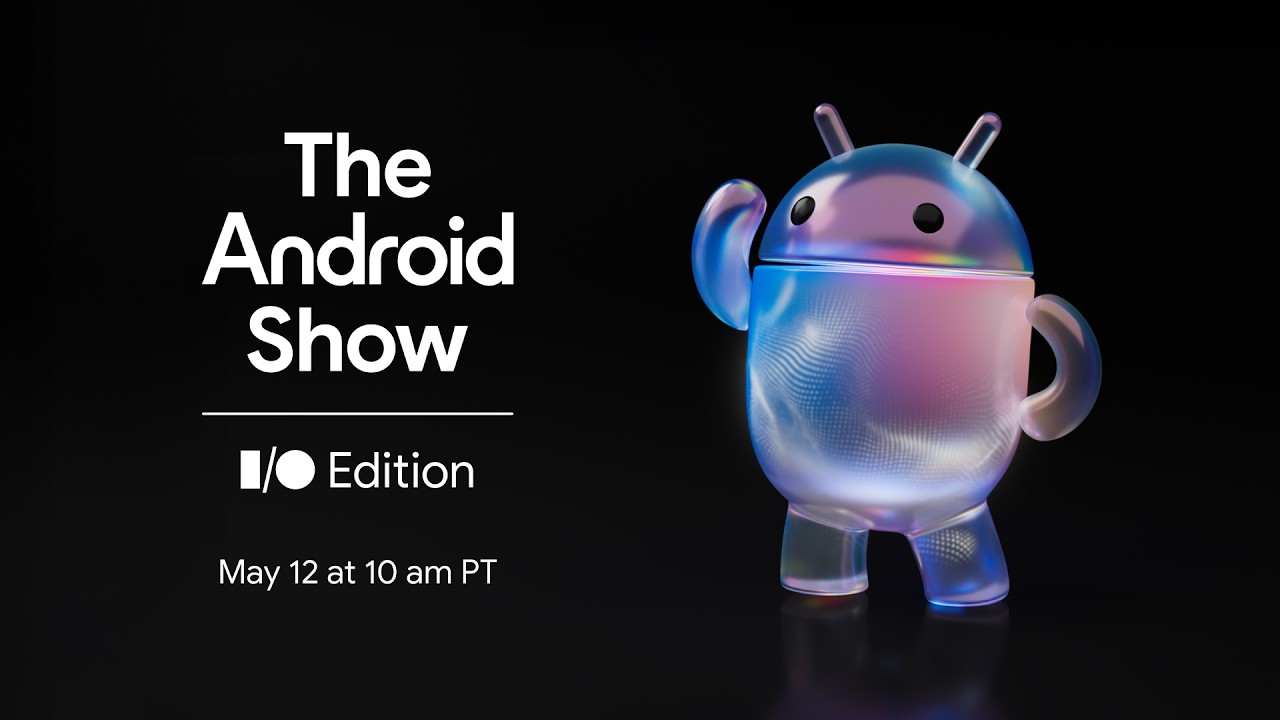
The Android Show I/O Edition 2026 takes place today, May 12th, at 7 PM Paris time. Google promises an exceptional edition for Android this year, with Android 17, Aluminium OS, and Android XR on the agenda.
An event to follow live on YouTube
The format is identical to the one launched last year: a pre-recorded event, broadcast via streaming on the official Android YouTube channel, before the Google I/O conference which opens on May 19th, 2026. The broadcast begins at 10:00 AM Pacific time, which is 1:00 PM in New York and 7:00 PM in Paris. To avoid missing the start, the « Remind me » button available on the event’s YouTube page allows you to receive a notification when it launches.
The dedicated official page is accessible at android.com/io-2026, where Google has chosen to centralize all announcements related to the Android ecosystem for this 2026 edition. For users who cannot follow the live stream, the replay will be available immediately after the event ends.
Why Google is separating Android from Google I/O
This second edition of The Android Show follows a clear logic. Since 2025, Google has dedicated the majority of the main I/O keynote to artificial intelligence and Gemini, at the expense of consumer Android announcements. By isolating Android’s innovations in a separate event, held a week before the developers’ conference, the Mountain View firm is giving its operating system the visibility it deserves. On its official website, Google presents this edition as « one of the biggest years for Android yet ».
In 2025, this format allowed for the presentation of Material 3 Expressive, the extension of Gemini to Android Auto and Wear OS, as well as Find Hub. For 2026, the ambitions seem even broader, with at least four major topics on the table.
Android 17: a solid update, without a visual revolution
Android 17 is the central pillar of the event. The system is currently in an advanced beta phase: Google released Beta 4 on April 16th, 2026, described as a « near-final environment » by the Android team. The stable version is expected in June 2026, according to Google’s usual schedule, which launched Android 16 on June 10th, 2025.
One thing is already certain: there will be no visual overhaul comparable to Apple’s Liquid Glass. Google itself dismissed this possibility the week before the event. However, the beta builds reveal several concrete improvements, including a « Motion Cues » feature designed to reduce motion sickness when using the phone in a car, better support for large screens and tablets, and a native system for reconfiguring game controllers, directly accessible in system settings. The Proactive Assistance feature, linked to Gemini, is also expected, allowing the assistant to suggest contextual actions without the user having to explicitly ask.
Aluminium OS: the Android-ChromeOS merger takes shape
The most anticipated topic by observers of the Google ecosystem remains undoubtedly Aluminium OS. This project, whose name first appeared in an internal job posting, aims to unify Android and ChromeOS into a single platform for laptops and desktops. Sameer Samat, Vice President of the Android ecosystem at Google, confirmed the project’s existence in July 2025. Software screenshots have since leaked via a bug report, fueling growing anticipation.
Google has never publicly presented Aluminium OS beyond this initial confirmation. The Android Show, being more consumer-focused than the developer-centric I/O keynote, seems to be the most appropriate setting for a first demonstration. It remains to be seen whether Google will limit itself to an update on the project’s progress or if a launch date will be announced.
Android XR: connected glasses at the heart of the device
Android XR represents the third major focus of the event. Google’s mixed reality platform, presented at I/O 2025, is gradually taking shape. On the hardware side, the Samsung Galaxy XR is currently the only headset sold under Android XR. For smart glasses, Google has partnered with several renowned optics manufacturers: Warby Parker, Gentle Monster, and XREAL are among the companies involved in the ecosystem.
These collaborations suggest a broader and more accessible offering than what Google Glass was able to provide in its time. The ambition is to position Android XR as an open platform, capable of hosting devices at different price points. The Android Show is an ideal opportunity for Google to provide details on the public availability timelines for these products, some of which have already been shown as prototypes at international trade shows.
Gemini and what we probably won’t see tonight
Announcements related to Gemini are expected to remain partial during The Android Show. Google will likely reserve the most significant updates for the model, potentially a version 4.0 or a major 3.x update, for the main keynote on May 19th. Nevertheless, new integrations of Gemini into the Android interface are expected starting tonight.
What will not be on the agenda: the Pixel 11. The latest flagship Pixels were launched in August in recent years, and this cycle is not expected to change in 2026. However, Google did present the Pixel 7 at an I/O event, six months before their actual release, which leaves a slight margin for surprise.
The Android Show I/O Edition 2026 promises to be the densest Android event in several years. For those who wish to follow the event live, simply go to the Android YouTube channel at 7 PM Paris time on May 12th. The Google I/O 2026 conference, dedicated to developers, will follow from May 19th to 20th to delve deeper into technical announcements and Gemini updates.