Siri AI will not be available in Europe on iPhone in Fall 2026. The DMA blocks the launch of Apple Intelligence in France and 26 other EU countries.
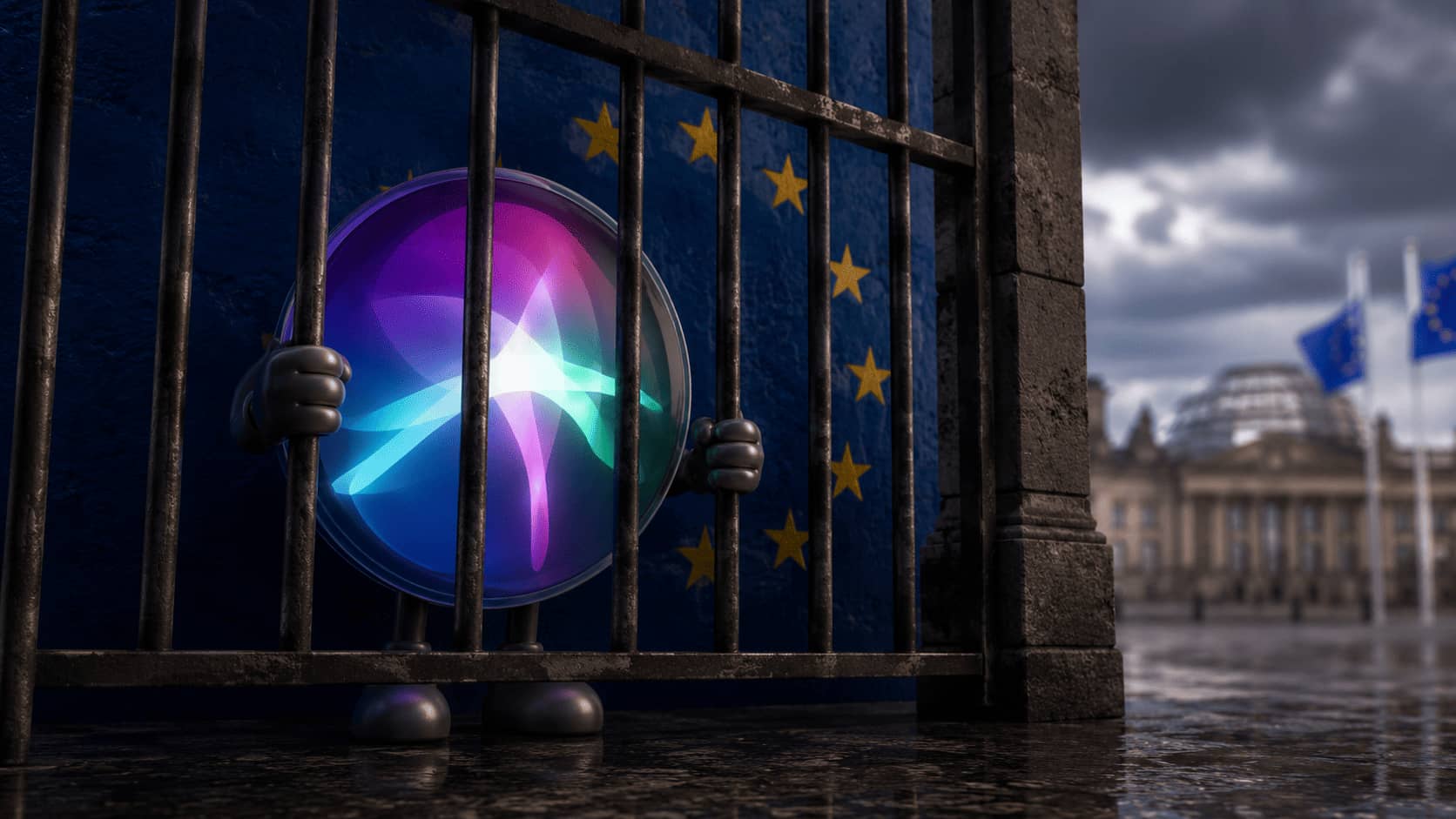
On June 8, 2026, Apple unveiled Siri AI at WWDC 2026: a complete overhaul of its personal assistant, powered by Apple Intelligence and co-developed with Google using its Gemini models. More conversational, capable of acting directly within apps, analyzing what the camera sees, and understanding each user’s personal context, Siri AI represents the most ambitious software transformation for the iPhone in years. For US users, deployment is expected in Fall 2026. For the 450 million European iPhone and iPad users, it’s a different story.
The European Union has once again missed the train on a major artificial intelligence innovation. After the postponement of Apple Intelligence in 2024, it’s now Siri AI Europe’s turn to stay on the platform, with no known catch-up date. This is not a technical delay. It’s a regulatory impasse between Cupertino and Brussels, revolving around an issue that touches on what Apple considers its most fundamental commitment to its users: privacy.
Siri AI in Europe: What iPhone Users Are Concretely Losing
The situation warrants precise explanation. When iOS 27 and iPadOS 27 are launched in Fall 2026, all residents of the 27 European Union member states will not have access to Siri AI on their iPhone and iPad. This affects all the advanced features presented at WWDC 2026: the dedicated Siri app that retains conversation history (similar to ChatGPT or Gemini), extended visual intelligence that allows the assistant to analyze what the camera is filming in real-time, the writing tools integrated into all apps, and the Siri mode directly accessible from the Camera app.
The situation has an important distinction. Apple confirmed in its official statement on June 8, 2026, that Siri AI will indeed be available for European users on macOS 27, visionOS 27, and watchOS 27. These platforms are not subject to the same Digital Markets Act (DMA) obligations as the iPhone and iPad, which are designated as gatekeeper operating systems. The divide therefore precisely affects the two most used devices daily. This means the core of the Apple mobile experience in Europe remains on hold.
Data Security: The DNA Apple Cannot Compromise
To understand this blockage, we must go back to what has defined Apple for two decades. Privacy is not just another selling point for the Cupertino brand; it’s a structural positioning that profoundly influences purchasing decisions. A significant portion of users choose an iPhone precisely for these guarantees that neither Android nor competing AI assistants offer on the same terms. On-device data processing, end-to-end encryption, explicit consent for every access to personal data: these principles have been integrated into the very architecture of iOS since its early versions.
Siri AI is designed in this continuity. According to Apple’s official statement on June 8, 2026, the assistant is « private by design » and relies on on-device processing combined with Private Cloud Compute, the proprietary infrastructure that extends the iPhone’s privacy level to the cloud. In concrete terms, processed data is neither stored nor accessible, even by Apple.
It is precisely this model that the company claims it cannot maintain under the DMA requirements as interpreted by European regulators. According to Apple, Brussels would demand that, at the very moment Siri AI would be made available in the EU, any third-party virtual assistant receive direct access to users’ private data and the ability to control installed applications, without the essential protections that Apple considers indispensable. Messages, purchases, files, account settings: a user’s entire digital life would potentially be accessible to any AI model. Apple reminds in its statement that security researchers have already demonstrated that AI systems can be misused to exfiltrate passwords or photos without their owner’s consent.
This scenario goes against everything millions of European users chose an iPhone for. The irony is real: the European regulation intended to protect consumers by expanding their choices would, in this specific case, expose their personal data to a level of risk that no user has requested.
Trusted System Agent: The Compromise Offer Dismissed by Brussels
Apple did not come to negotiations with the European Commission without proposals. The company indicates it worked for several months on a technical solution called Trusted System Agent: a secure intermediary that would have allowed competing virtual assistants to access the same functionalities as Siri AI on devices in the EU, without directly exposing personal data. The architecture aimed to reconcile the DMA’s interoperability requirements with Apple’s security standards. The company had also proposed a phased rollout over 18 months to implement this solution in a controlled and iterative manner.
The European Commission rejected all these proposals. « We’re deeply disappointed that our EU users won’t have Siri AI on iPhone or iPad when we share our new software releases later this year, » said Craig Federighi, Apple’s Senior Vice President of Software Engineering, in an official statement. « Given that regulators have refused to engage constructively in finding privacy and security preserving solutions, we currently do not have a timeline for availability of Siri AI on iOS and iPadOS in the EU, » he added, in the same statement.
Two Incompatible Narratives, a Europe That Waits
The European Commission disputes Apple’s version with unambiguous clarity. On June 9, 2026, Thomas Regnier, a Commission spokesperson, stated at a press conference in Brussels that « The decision not to roll out Siri AI in the EU is Apple’s and Apple’s only. » According to Brussels, no provision of the DMA prohibits Apple from introducing new products or services in the European Union. The European executive accuses the company of not having sought to build a viable interoperability solution, but of having requested a complete exemption from its regulatory obligations for at least 18 months, which regulators refused to grant.
The two parties are therefore not arguing about the same reality. Apple speaks of concrete security risks and the technical impossibility of complying with DMA requirements without exposing users. The Commission speaks of a lack of viable compliance solutions and a deliberate blocking strategy. This impasse is not new: in April 2025, Apple was fined €500 million, the first penalty ever issued under the DMA, for its App Store restrictions.The file also contains a paradox that observers have quickly noted. Siri AI, presented by Apple as a privacy-respecting assistant, technically relies on a partnership with Google and its Gemini models, formalized by a multi-year agreement announced in early 2026. It is therefore Google’s infrastructure, one of the players whose access to the iPhone’s system functionalities is precisely at the heart of the dispute with Brussels, that powers Apple’s new assistant. This technical reality complicates the discourse on the purity of the data processing chain, without invalidating the security concerns raised by Apple.
While this standoff continues, European iPhone users are waiting. Apple says it wants to « continue to engage » with regulators, but without any timeline. The Commission, for its part, has signaled no intention of changing its position. The rift between Europe and the rest of the world regarding artificial intelligence widens with each launch cycle. For the millions of French and Europeans who chose an iPhone precisely for the privacy guarantees it offers, the situation is particularly paradoxical: it is their own regulation that is currently depriving them of a technology designed around the values they have chosen.