ChatGPT Personal Finance: On May 15, 2026, OpenAI launched a feature allowing users to connect their bank accounts to the AI for personalized budgeting advice.
A clear ambition: replace your budgeting app
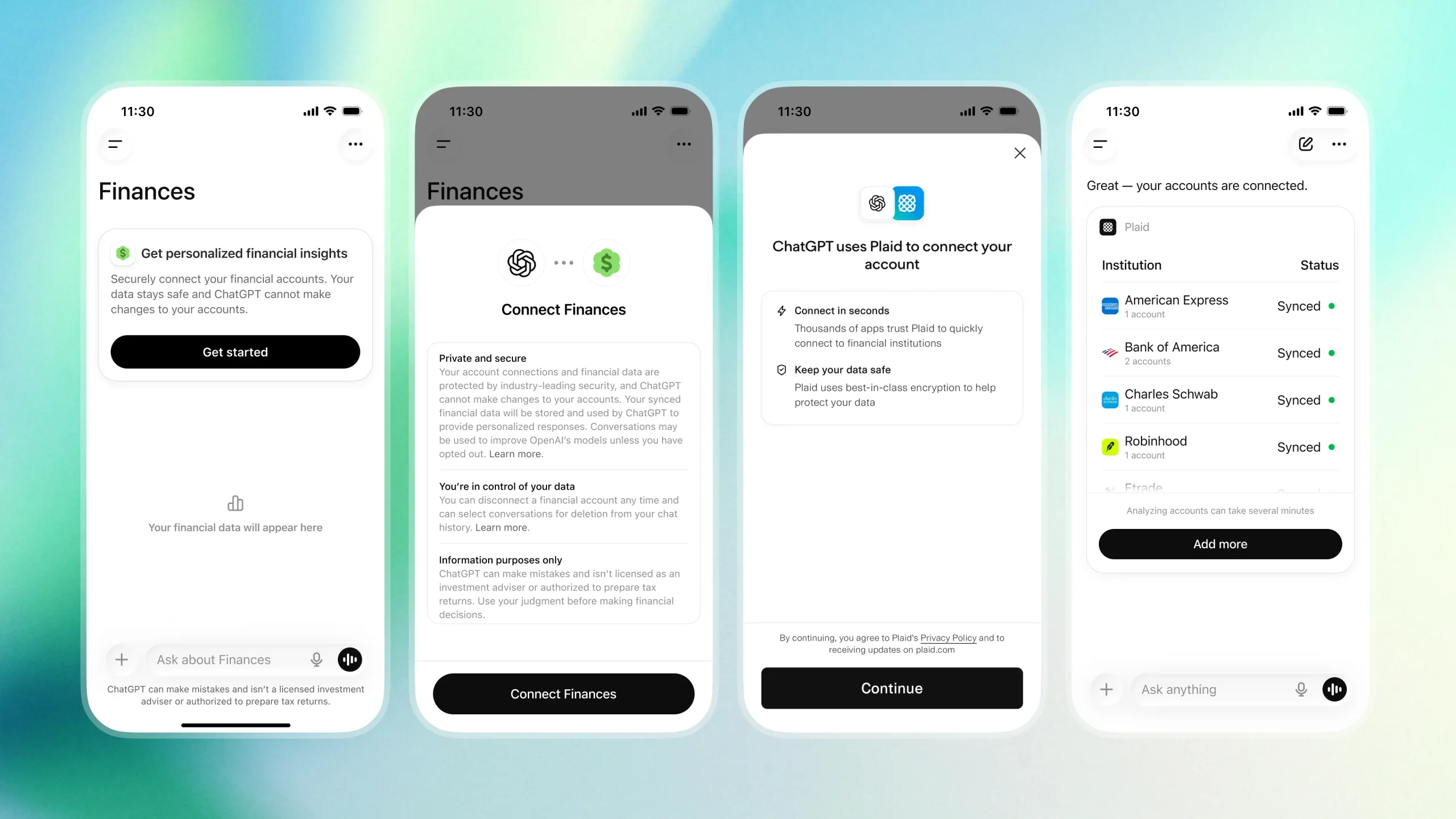
OpenAI launched a suite of personal finance tools on Thursday, May 15, 2026, in a preliminary version for ChatGPT Pro subscribers in the United States, enabling them to connect their accounts and ask questions ranging from expense analysis to future financial planning. This is not a mere cosmetic update. It represents a profound shift for a chatbot that until now advised blindly, never knowing the reality of your financial situation.
According to OpenAI, over 200 million users already ask ChatGPT financial questions each month. The promise of this new feature is therefore simple: to transform these generic exchanges into personalized analyses, anchored in the user’s real data. Less theoretical advice, more concrete answers based on what you truly spend.
How account connection works
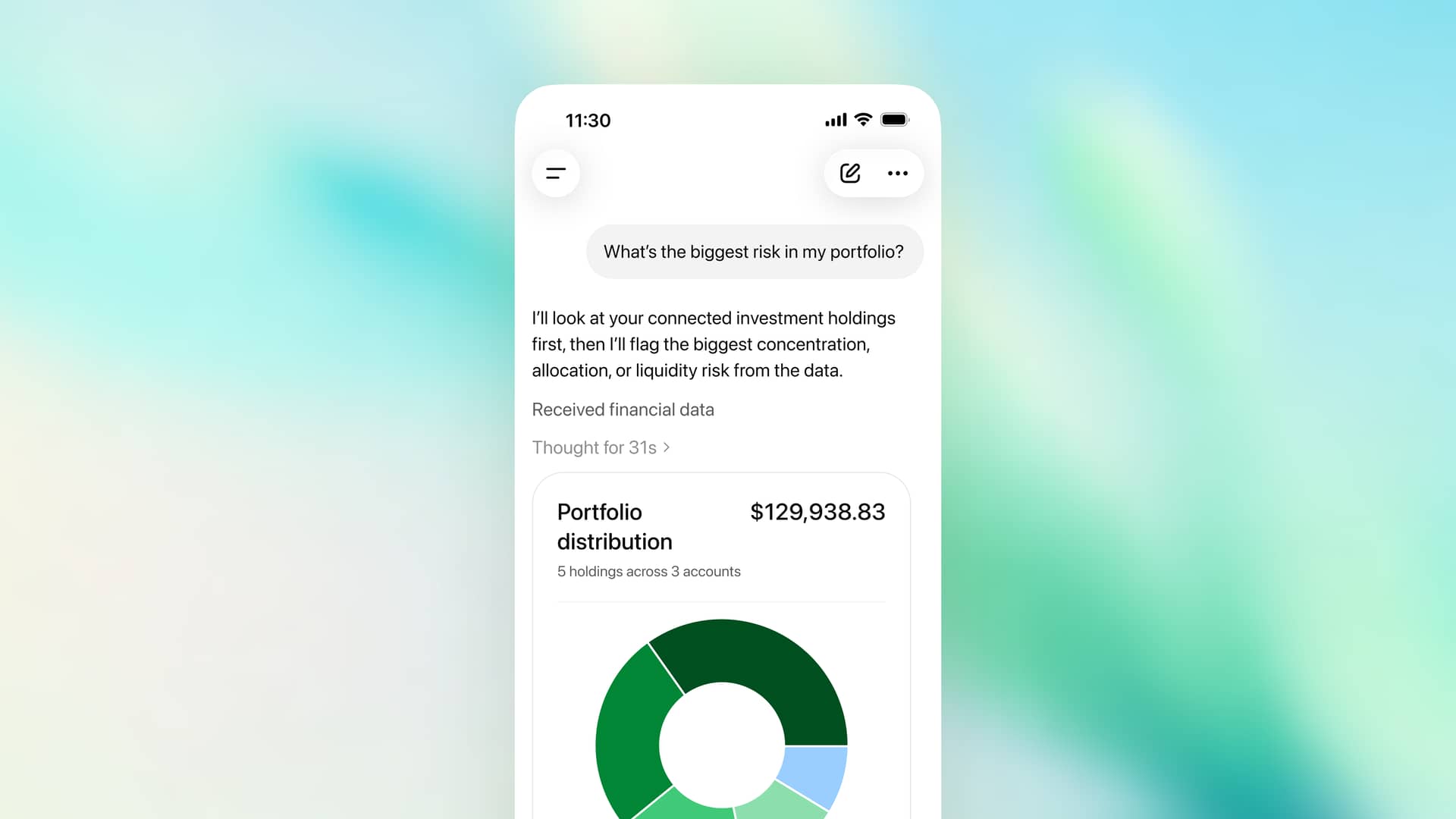
To get started, users can open the new « Finances » section in the ChatGPT sidebar and tap « Get Started, » or type « @Finances, connect my accounts » in a conversation. OpenAI has chosen to rely on the Plaid service to manage account connections, providing access to over 12,000 financial institutions, including Schwab, Fidelity, Chase, Robinhood, American Express, and Capital One.
Once accounts are linked, ChatGPT generates a dashboard displaying spending habits, investment portfolio performance, active subscriptions, upcoming payments, and other up-to-date financial data. The stated goal is to allow users to interact with their finances in natural language, without having to interpret charts or juggle multiple applications.
Users can also provide additional financial context manually, for example, by informing ChatGPT of a planned real estate purchase, a family loan, or a savings goal. OpenAI indicates that this information can be saved as « financial memories » to improve future interactions.
GPT-5.5 at the heart of the financial engine
The personal finance feature relies by default on GPT-5.5 Thinking, OpenAI’s latest reasoning model available in ChatGPT. The company states it worked with over 50 finance professionals to evaluate the experience on complex tasks. GPT-5.5 Thinking scored 79 out of 100 on the internal personal finance benchmark, while GPT-5.5 Pro achieved 82.5 out of 100.
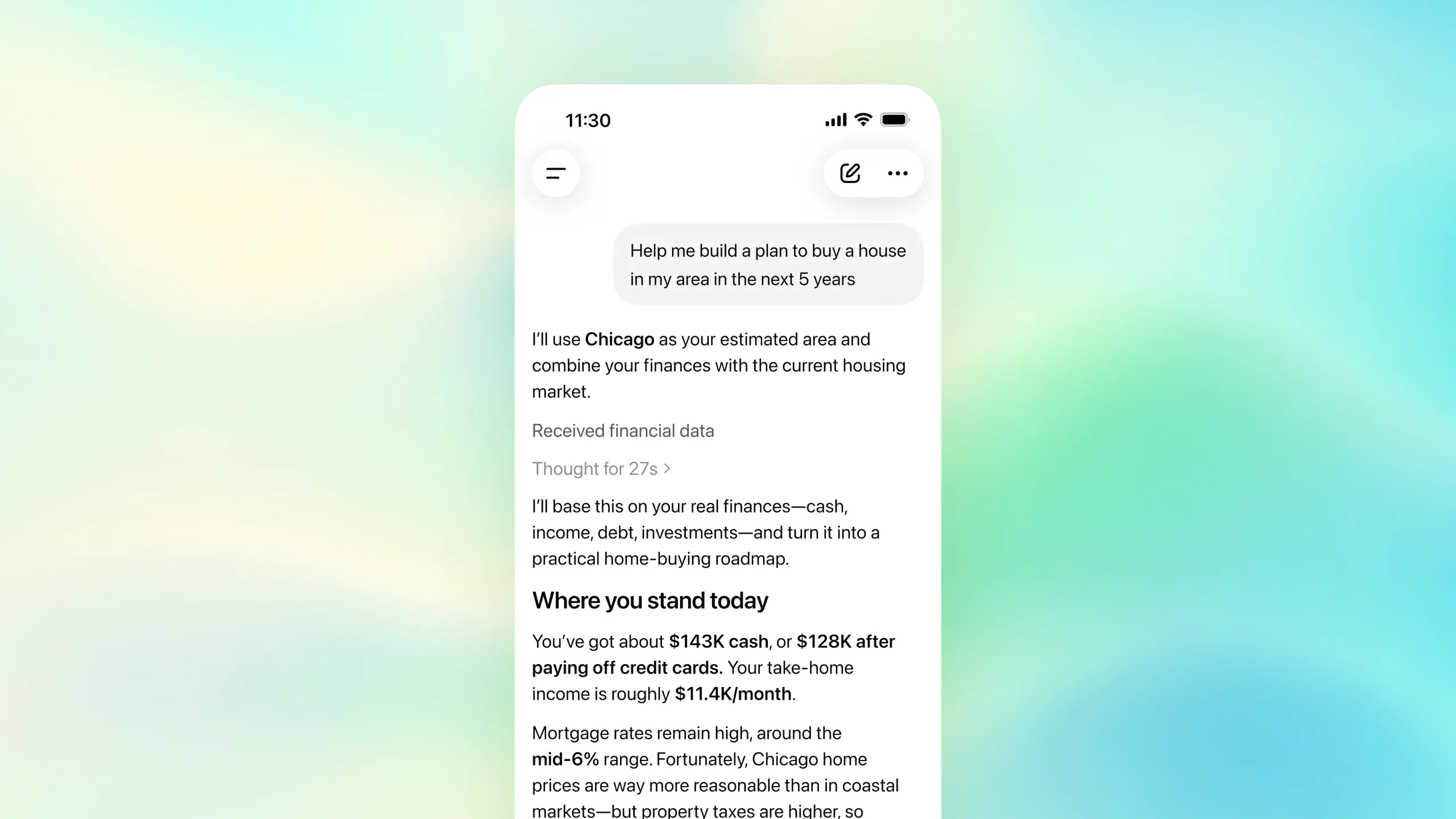
The model is also capable of analyzing trends, not just isolated financial events. It can highlight monthly spending variations over twelve months and generate multi-year budget roadmaps. This level of longitudinal analysis goes beyond what most traditional budget management applications offer, which typically provide a static display of transactions.
The question of trust and personal data
This is undoubtedly the most sensitive point of this announcement. Connecting a conversational assistant to your bank statements, investments, and debts represents an unprecedented level of access. OpenAI specifies that ChatGPT can view balances, transactions, investments, and debts, but it cannot see full account numbers or make changes to accounts.
Users can disconnect their accounts at any time from the settings or the Finances page. OpenAI indicates that synchronized data will be deleted from its systems within 30 days of disconnection. Temporary conversations in ChatGPT do not access connected financial accounts and do not retain financial history.
Ty Geri, Product Lead at OpenAI, stated in an official press release: « Finances are deeply personal and shaped by individual goals, priorities, and everyday realities. But understanding the full picture of your personal finances can be difficult because information is spread across different apps, accounts and spreadsheets. »
A launch rooted in a broader strategy
This launch comes just one month after OpenAI acquired the team behind the personal finance startup Hiro, backed by funds like Ribbit, General Catalyst, and Restive, in April 2026. OpenAI indicated that the Hiro team’s financial expertise was instrumental in launching this product. This acquisition, quickly followed by a product launch, signals a desire to quickly establish a foothold in the consumer financial tools market.
The launch date also coincides with the announcement of upcoming Intuit support, which is expected to enable more advanced use cases, such as estimating the tax impact of a stock sale or predicting the approval chances for a credit card.
Availability: Pro only, Android absent
The feature requires a ChatGPT Pro subscription, priced at $100 per month. The $20 per month ChatGPT Plus subscription does not yet support the new personal finance experience. OpenAI wishes to gather feedback from early Pro users to improve the product before making it available to Plus subscribers.
Android users will have to wait longer. The rollout is currently limited to the web and iOS, with no announced timeline for expansion to other platforms. OpenAI specified in a blog post that it plans to make these features accessible to all users, suggesting they might eventually be available on free accounts.
The question is not whether AI will become dominant in daily budget management, but how quickly. OpenAI is crossing a symbolic threshold here, moving from general advice to personalized financial analysis. For those willing to grant this level of access to an online service, the tool clearly deserves particular attention. For others, it remains to be seen whether more formal privacy guarantees, or a lower price point, will change perceptions.